
December 4, 2024
The Arctic can be a challenging place for technology, with remoteness, harsh weather and freezing temperatures adding a layer of complexity. Add to that the Canadian Armed Forces’ requirements for rugged, reliable power and energy generation, and the Government of Canada’s commitment to net-zero emissions in its operations by 2050, and you’ll get the challenge set before Defence Research and Development Canada (DRDC) and their collaborative partners in a multi-year research initiative.
Dr. Gisele Amow, the lead defence scientist at DRDC for this initiative, explains her research to make Arctic facilities more sustainable began with the Advanced Microgrids towards Arctic Zero Emissions (AMAZE) project in 2020, with three years of funding from the Greening Government Fund.
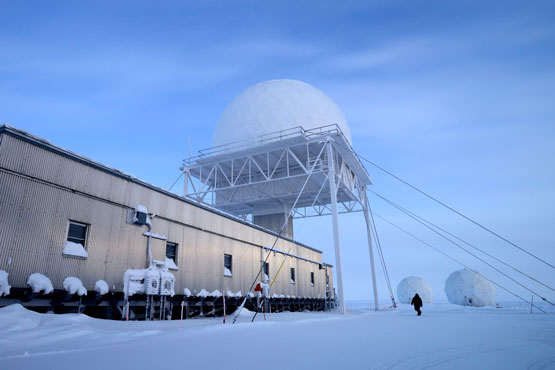
The AMAZE and AMAZE 2.0 projects aim to make Arctic facilities, like the CAM-Main North Warning System Site at Cambridge Bay, Nunavut shown here, more sustainable.
Defence buildings and assets in Canada’s Far North use significant amounts of fuel for electricity and heating because of their remote locations and the extreme cold. This includes the North Warning System (NWS), which is a chain of long and short-range air defence radar sites to provide aerospace surveillance in the North to the bilateral North American Aerospace Defence Command (NORAD).
The AMAZE project has aimed to improve sustainability planning in the Arctic through an integrated systems approach that includes variable speed generators, thermal energy management, renewable energy systems and advanced microgrid controls.
“Microgrids are self-sufficient energy systems for specific locations that can be made up of one or multiple distributed energy sources. One example would be a single diesel generator, another would be a combination of solar panels, wind turbines, and batteries,” Dr. Amow says.
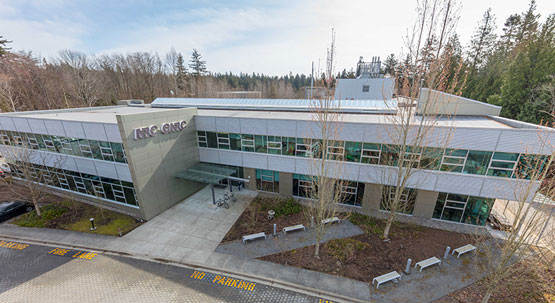
Outside view of the National Research Council Canada’s Microgrid testing facility in Vancouver, Canada.
Through the AMAZE project, DRDC has contributed to establishing the National Research Council microgrid testing facility in Vancouver, British Columbia, that can be used to test, de-risk, and optimize different power and energy technologies in a microgrid configuration. Additionally, the project was successful in developing energy models for selected long-range and short-range radar North Warning System sites, which has identified the equivalent of up to 325,000 L in onsite fossil fuel reductions and associated greenhouse gas emissions, if all measures are implemented.
“Through AMAZE, we’ve discovered opportunities for more than 40 per cent of fossil fuel reductions at selected northern facilities through energy saving measures,” says Dr. Amow, adding that even more savings could be realized if renewable energy technologies are used.
The research is now continuing as AMAZE 2.0 with funding from Canada’s NORAD modernization plan, announced in June 2022. Canada has committed to investing $4.23 billion over 20 years in science and technology to advance to defend Canada. AMAZE 2.0 is part of the “Powering the North” research initiative under this investment.

DRDC worked with partners, Natural Resources Canada’s CanmetENERGY and the National Research Council of Canada, to record heat loss from buildings at a North Warning System site in Nunavut with a thermal camera, as part of the AMAZE project.
Both AMAZE and AMAZE 2.0 are conducted in collaboration with Natural Resources Canada’s (NRCan) CanmetENERGY and the National Research Council of Canada (NRC). The collaboration is mutually beneficial, as the project aims to de-risk technologies and guide recommendations for civilian applications in the Arctic and Canadians in general.
“Collaborating with other departments has been key to successes to date to develop concrete solutions for a more sustainable future in very challenging environmental conditions that is the Arctic,” says Dr. Amow.
Through AMAZE 2.0, DRDC will procure a hybrid microgrid system for real world deployment and data collection at a North Warning System site and will continue to expand and implement emerging technologies at NRC’s microgrid test facility.