
January 29, 2025
Making decisions under pressure is difficult, especially when the consequences can be dire. Deployed Canadian Armed Forces (CAF) personnel can face situations that can implicate their fundamental values and principles. Making the right decision in these cases is critical. Yet, in some of these cases, negative consequences can occur no matter what choice is made. Such moral and ethical dilemmas are difficult to address and can impact the short and long-term mental wellbeing of personnel.
Defence Research and Development Canada’s Toronto Research Centre, in collaboration with researchers from the National Research Council of Canada’s Medical Devices Research Centre, have begun to address this challenge for current and future military operations by evaluating the effectiveness of virtual reality training.
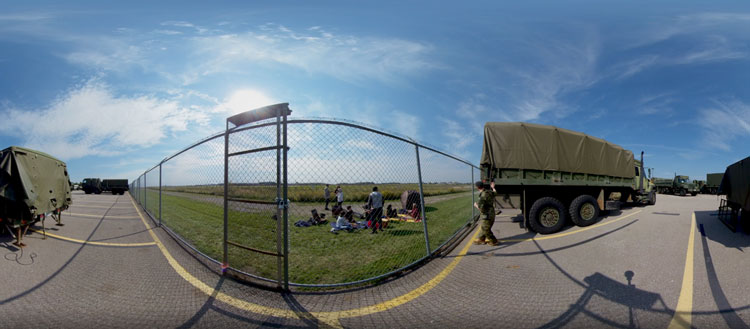
Defence Research and Development Canada and the National Research Council of Canada are conducting research to evaluate the effectiveness of virtual reality training for moral decision making.
The first step in this program of research is developing a method to assess the value and impact of virtual reality (VR) training as one way to better prepare military personnel for the moral decision-making challenges they may encounter during operations. To do this, decision-making processes and physiological (e.g., participant heart rate variability) and psychological (e.g., shame, guilt) responses are assessed before, throughout and shortly after experiencing a VR moral scenario. These same factors are compared when reading a paper and pencil presentation of the same scenario.
An important consideration for the researchers is to optimally train personnel, while being mindful of the potential for traumatization from the scenarios themselves. Thus, the research team is also beginning to explore the requirements of creating an intelligent adaptive VR solution, which could alter aspects of the VR experience in real-time with an ultimate goal of creating an immersive, personalized experience calibrated to the individual user.
“Ultimately, we hope that our research will be an important support to CAF personnel, providing our troops with a safe space to navigate how they might react in these difficult situations in an upcoming deployment. An additional longer-term goal is to see if such training might even reduce the potential for negative psychological consequences like moral distress and moral injury during deployments and after personnel return home,” says Dr. Megan Thompson, Defence Scientist at DRDC.
This project aims to accomplish the following:
- Give CAF members an opportunity to prepare for moral and ethical dilemmas, by working through and making decisions regarding these challenging situations in a controlled and immersive virtual setting.
- Determine whether such training might also buffer the shorter and long-term negative psychological impacts of moral challenges in operations.
- Provide researchers, trainers, and clinicians with a deeper understanding of the psychological and physiological impact of ethical challenges both overall and in a VR environment.
By utilizing evolving technology like intelligent adaptive VR, DRDC hopes to ensure CAF members are on the forefront of preparedness, even in morally and ethically trying situations.