
Download the alternative format
(PDF format, 284.77 KB, 2 pages)
Organizations: Produced in partnership by National Research Council Canada and Defence Research and Development Canada.
Published: 2023
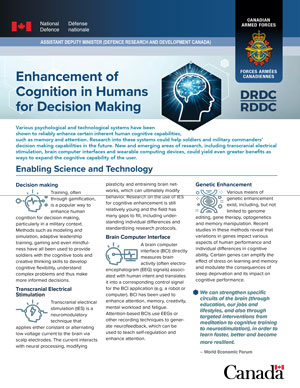
Various psychological and technological systems have been shown to reliably enhance certain inherent human cognitive capabilities, such as memory and attention. Research into these systems could help soldiers and military commanders’ decision making capabilities in the future. New and emerging areas of research, including transcranial electrical stimulation, brain computer interfaces and wearable computing devices, could yield even greater benefits as ways to expand the cognitive capability of the user.
Enabling science and technology
Decision making
Training, often through gamification, is a popular way to enhance human cognition for decision making, particularly in a military context. Methods such as modeling and simulation, adaptive leadership training, gaming and even mindful- ness have all been used to provide soldiers with the cognitive tools and creative thinking skills to develop cognitive flexibility, understand complex problems and thus make more informed decisions.
Transcranial Electrical Stimulation
Transcranial electrical stimulation (tES) is a neuromodulatory technique that applies either constant or alternating low voltage current to the brain via scalp electrodes. The current interacts with neural processing, modifying plasticity and entraining brain net- works, which can ultimately modify behavior. Research on the use of tES for cognitive enhancement is still relatively young and the field has many gaps to fill, including under- standing individual differences and standardizing research protocols.
Brain Computer Interface
A brain computer interface (BCI) directly measures brain activity (often electro-encephalogram (EEG) signals) associated with human intent and translates it into a corresponding control signal for the BCI application (e.g. a robot or computer). BCI has been used to enhance attention, memory, creativity, mental workload and fatigue. Attention-based BCIs use EEGs or other recording techniques to generate neurofeedback, which can be used to teach self-regulation and enhance attention.
Genetic Enhancement
Various means of genetic enhancement exist, including, but not limited to genome editing, gene therapy, optogenetics and memory manipulation. Recent studies in these methods reveal that variations in genes impact various aspects of human performance and individual differences in cognitive ability. Certain genes can amplify the effect of stress on learning and memory and modulate the consequences of sleep deprivation and its impact on cognitive performance.
“We can strengthen specific circuits of the brain (through education, our jobs and lifestyles, and also through targeted interventions from meditation to cognitive training to neurostimulation), in order to learn faster, better and become more resilient.”
Signals
Academic
University of Oxford has researched the ethical and moral issues associated with using drugs to enhance cognition, and whether cognitive enhancers can produce morally better decisions.
Government
While most western governments do not financially support or have social support for genetic enhancement, China is moving forward with research to genetically enhance humans.
Collaboration
King’s College London and University College London collaborated on a 2017 primer called Transcranial Electrical Stimulation that highlights important concepts and misconceptions surrounding the technique and outlines possible avenues for future research.
Defence
U.S. Army’s Interfaces for Collaboration and Decision Making studies how networks influence and are influenced by human behavior in the context of military decision making.
Corporate
Stottler Henke Associates Inc has developed an intelligent, adaptive, training tool that is integrated into an existing tactical decision making game called ‘Follow Me’, used by cadets at the US Military Academy, West Point.
“We are on a path to a world in which it will be possible to decode people’s mental processes and directly manipulate the brain mechanisms underlying their intentions, emotions and decisions; … such that their mental … abilities are greatly enhanced.”
Impact
Social
Public perception of cognitive enhancement is shifting from apprehension and misunderstanding to cautious realism with increasing use in academic communities. Close attention to scientific facts on efficacy and long term side effects will influence public perception of safety, autonomy, and legal issues.
Policy
There is a need to create policies and regulatory interventions for the use of neuropharmaceuticals and transcranial electrical stimulation for cognitive enhancement. Public discourse, norms of safe use, raising awareness and education can all contribute to reducing harm and helping to ensure public safety.
Economic
Collaboration between government and industry to develop cognitive enhancement methodologies, tools and decision support systems may have a positive impact on the Canadian economy.
Environmental
Enhanced cognition could provide new insights on resource optimization, contributing to greening Defence.
Defence
As cognitive enhancement speeds up learning and decision making, the military can reduce the cost and duration of its extensive training and readiness programs, while improving outcomes.
“Decisions made during war are literally matters of life and death, and any enhancement to moral decision-making in warfare would surely be a welcome development. But, if any cognitive enhancement…. were to undermine the capacity of a subject to follow the law of armed conflict, it would be a source of very serious concern.”
Contact information
Produced in partnership by the National Research Council of Canada and Defence Research and Development Canada.
August 2018 · Également disponible en français
© His Majesty the King Right of Canada as represented by the Minister of National Defence, 2023
Cat. No.: D69-81/2023E-PDF
ISBN: 978-0-660-49812-6