
July 18, 2024
During a recent counter-drone demonstration event, Canada became the fifth NATO country to test above-the-horizon lasers to defeat drone threats without a mountain or other geographic backdrop to stop the laser.
In fact, two Canadian innovators, Boeing and AIM Defence, successfully conducted above-the-horizon laser tests during the Innovation for Defence Excellence and Security (IDEaS) program’s Counter Uncrewed Aerial Systems (CUAS) Sandbox from May 27 to June 21, 2024 at Defence Research and Development Canada (DRDC)’s Suffield Research Centre.
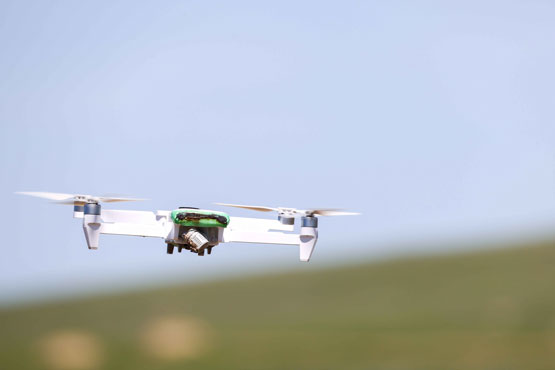
Boeing and AIM Defence successfully tested laser-based systems to counter drones at the IDEaS CUAS Sandbox in Suffield, Alberta in May and June 2024.
In order to safely conduct this test, scientists carefully coordinated with air traffic, space operations, and even the International Space Station. This event was enabled by the proactive efforts of the National Defence Laser Safety Office which defined the first laser weapon safety templates, implemented new safety metrics, and established a coordination process via the 3rd Canadian Space Division to the U.S. Space Force for real-time space asset deconfliction.
“Canada is interested in exploring this novel technology because lasers are a potential cost effective and expedient way of defeating drones. Lasers can also provide a solution that minimizes collateral damage when compared to guns,” explains Matt Ceh, a defence scientist with DRDC Suffield Research Centre.
Ceh, who was the lead defence scientist for this CUAS Sandbox, adds that research trials are a necessary step to provide science-based advice to the Department of National Defence and Canadian Armed Forces (DND/CAF) on the potential benefits and threats of new technology. For example, with laser-based counter drone technology, there is a potential risk of reflections off a target. The Sandbox allowed innovators to safely test with a variety of drones targets and scenarios.

Canada became the fifth NATO country to test laser-based counter drone systems without a geographic backdrop, at the IDEaS CUAS Sandbox in Suffield, Alberta in May 2024.
The goal of the Sandbox was to continue to advance counter-drone technologies to keep pace with drones that are faster, smaller, less detectable and being used in military conflict in new and impactful ways.
“The testing and demonstration at the Sandbox was a win-win where innovators got access to unique testing facilities and feedback from military experts, and DND/CAF feedback can help innovators develop their technology with the real-world needs of the CAF in mind to prepare for our future capabilities needs. This event was important for DND as it demonstrated to our Allies that Canada is now ready for testing and training with laser weapons in a variety of tactically relevant scenarios,” Ceh explains.
DRDC Suffield has hosted three IDEaS Sandboxes, in 2019, 2022, and 2024, on its unique experimental proving grounds, one of the world’s largest instrumented outdoor laboratories at approximately 500 square kilometres. The remote, flat location offers an ideal place to safely conduct iterative testing and demonstration to improve prototype counter-drone technologies. The IDEaS program also offers a red team of “hostile” drones to act as targets and imitate real-world threats such as swarm attacks and attacks with various drone types.
At the most recent Sandbox, conducted from May 27 to June 21, 2024, 15 innovators from five countries, including Canadian companies, tested their counter drone technologies over the month-long event. During the demonstration, the innovators received feedback from experts in the CAF, the US Department of Defense Irregular Warfare Technical Support Directorate, Royal Canadian Mounted Police, and scientists.