
February 9, 2024
Defence scientist Inbal Marcovitch is working to ensure that standardization is part of the process as Canada and its allies work to rapidly adopt new green military technologies to respond to the climate crisis.
“Standardization is the invisible recipes and glues that holds our infrastructure together,” says Marcovitch, who is an acting section head at the Defence Research and Development Canada (DRDC) Centre for Security Science. “As we work towards a green future, where the Canadian Armed Forces can work together with allies with green power and energy and other sustainable solutions, we need to be integrating standardization into the adaptation strategies and processes as we go along.”
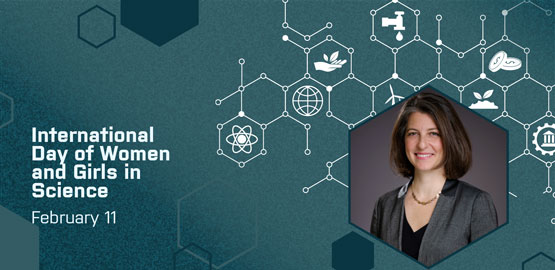
DRDC Centre for Security Science defence scientist Inbal Marcovitch applies interdisciplinary science and technology foresight methods to the convergence of climate change, security, and standardization.
To understand the benefits of standardization, imagine trying to charge a device with the wrong charger or inserting the wrong fuel into a machine. Or try to compare two products with no common measuring criteria. For allied militaries having common standards to support adoption of new greener power and energy technologies enables interoperability to work together in the field in joint operations and exercises.
“As nations rapidly adopt innovative technologies to address climate-change, there is a risk of incompatibility between allied militaries,” Marcovitch explains. “The voluntary nature of standards, and their implementation to mitigate climate change means there can be inconsistencies in how and when nations are adopting new technologies, particularly in power and energy, which can lead to interoperability issues.”
Marcovitch works on standardization strategies and helping policy makers understand how standards, testing, verification and conformity assessment, can be used to ensure our investment in emerging technologies also address climate change adaptation needs and mitigates risks.
“Standards naturally have to follow the development of technology, but considering standardization during the early stages of technological development could shape the path of that technology. Ensuring collaboration, communication and alignment among allies occurs along the technological development path could preserve interoperability, assess the effectiveness of various solutions, and use evidence-based advice to inform policy choices,” Marcovitch explains.
The goal is to reduce the uncertainty, or “de-risk,” new technologies and solutions for use by the Canadian Armed Forces and Department of National Defence, as laid out in the recently published DND/CAF Climate Resilience and Environmental Sustainability Science and Technology Strategy.
Marcovitch’s work falls under the Strategic Analysis and Support to Operations work on foresight and risk assessment at DRDC’s Centre for Security Science. Marcovitch applies her background in economics and her previous experience working for the Standards Council of Canada (SCC) to help the Canadian Armed Forces and the Department of National Defence to expand the defence standardization tool box to address climate-change and security challenges while adhering to interoperability principles.
DRDC, which includes the Centre for Security Science (CSS), works with allies through The Technical Cooperation Program, which brings together the defence science organizations of Australia, Canada, New Zealand, the United Kingdom and the United States. The Centre for Security Science also works with the 5RD to enable cooperation on public security science among the same nations. Within the NATO community, Marcovitch contributes to the NATO S& collaborative programme of work (CPOW) on climate change and security, which advances sciences in climate change. The CPOW is synergizing with the recently launched NATO Climate Change and Security Centre of Excellence (CCASCOE) to further empower NATO militaries to adapt to the new environment and mitigate greenhouse gas emissions.