
June 17, 2024
Science, technology and innovation issues have become so complex that countries around the world need to collaborate more to solidify their research strategies. Countries are working together in developing innovative and inclusive science and technology policies to address the challenges facing the global population.
This was the context for the Organisation for Economic Co-operation and Development’s (OECD) series of international events that took place from April 22 to 24 in Paris, France, which concluded with the Committee for Scientific and Technological Policy’s (CSTP) ministerial meeting. This meeting allowed Ministers to discuss and offer strategic guidance on the future work of the CSTP; to strengthen relationships between members, non-members and international organizations; and to adopt a new action-oriented ministerial declaration.
Dr. Mona Nemer, Chief Science Advisor of Canada, represented the Honourable François-Philippe Champagne, Minister of Innovation, Science and Industry, at the events.
A full agenda of international meetings and dialogue
Dr. Mona Nemer is member of various national and international advisory councils and committees, a representative of Canada in scientific forums and a globally recognized spokesperson for Canadian science.
“It was a pleasure to represent Canada at the Multistakeholder high-level dialogue and the Committee for Scientific and Technological Policy’s ministerial meeting,” said Dr. Nemer. “Discussing themes like cooperation and competition with ministers and officials from other countries enabled us to strengthen our numerous international collaborations while drawing on best practices already in place elsewhere in the world.”
“I had the privilege of moderating the panel discussion on ocean data policies,” she added. “The ocean covers 71% of the planet’s surface, so we discussed the critical role of ocean observation data and key supporting infrastructure. Canada is involved in many initiatives relating to this, including in the Arctic or with a youth engagement focus. We have an obligation to raise awareness about the importance of continued ocean monitoring beyond the ocean research community.”
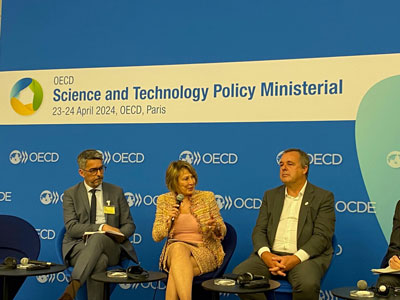
Dr. Nemer moderating “The ocean we want by 2030” panel discussion.
While in Paris, Dr. Nemer met with numerous foreign partners and officials:
- Oddmund Løkensgard Hoel, Minister of Research and Higher Education, Norway
- Bettina Stark-Watzinger, Federal Minister of Education and Science, Germany
- Martina Hirayama, State Secretary for Education, Research and Innovation, Switzerland
- Teresa Riesgo, Secretary General for Innovation, Ministry of Science and Innovation, and Juan Cruz Cigudosa, Secretary of State for Science, Innovation and Universities, Spain
- Mats Persson, Minister for Education, Sweden
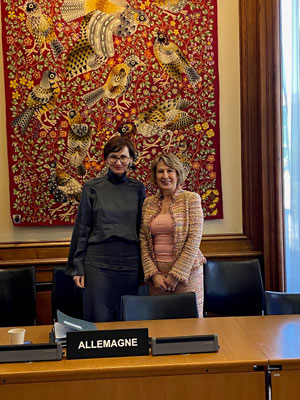
Dr. Nemer (at right) with Bettina Stark-Watzinger, Germany’s Federal Minister of Education and Science.
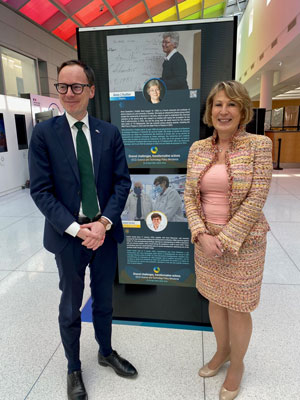
Dr. Nemer with Mats Persson, Sweden’s Minister for Education.
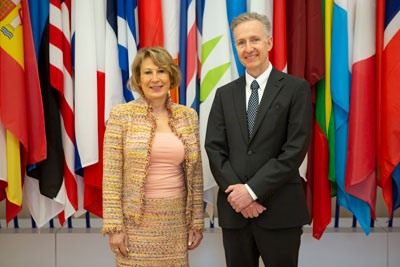
Dr. Nemer with Jerry Sheehan, Director of the OECD Directorate for Science, Technology and Innovation.
Canada well represented by its scientific community
This international meeting also enabled Canadian researchers to share their expertise. Dr. Kyle Bobiwash from the University of Manitoba, a researcher-in-residence in the Office of the Chief Science Advisor, spoke at the “Shaping science and technology policies for our future: how to engage diverse audiences?” plenary session. He applauded the launch of the Indigenous-themed STIP Compass portal—an online repository of science, technology and innovation policy initiatives focused on Indigenous knowledge and communities—and discussed Canada’s experiences in integrating Indigenous perspectives into policy development in these areas.
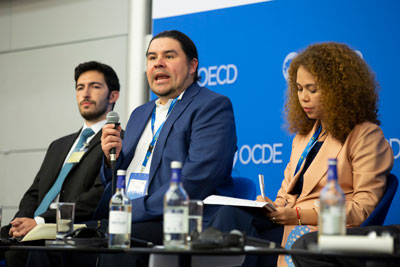
Dr. Kyle Bobiwash (centre) at the plenary session.
Dr. Wendy Cukier, Founder and Director of the Diversity Institute at Toronto Metropolitan University, and Dr. Henrietta Bennett, Chair of the Canadian Association of Postdoctoral Scholars, were also among the Canadian panellists. Dr. Cukier spoke about the role of skills and capabilities in the digital and green transitions, and Dr. Bennett participated in the panel on developing talent and promoting diverse research career paths in a world in transition.
A transformative, action-oriented declaration
In addition to the discussions, the main goal of this OECD ministerial meeting was the adoption of a new joint declaration to address the climate challenge, support the responsible development of science and technology based on shared values, and identify actions for international cooperation in these areas.
As set forth in the declaration, the signatory countries and the European Union commit to:
- developing and implementing transformative and more inclusive science, technology, and innovation agendas;
- continuing to invest in research and development;
- reinforcing the integration of shared values such as academic and scientific freedom, transparency, reciprocity, ethics, equity, diversity and inclusion, as well as research security;
- promoting voluntary and mutually beneficial exchanges of scientific knowledge and international cooperation that is open, fair, secure and equitable;
- making science, technology and innovation more inclusive, participatory and accessible; and
- supporting the collection of data to underpin the development of science, technology and innovation policies.
The Government of Canada has been involved in drafting this new declaration since July 2023. The declaration aligns with many Canadian priorities: fostering equity, diversity and inclusion; promoting open science and research security and integrity; and upholding the values of democracy and individual freedom, the rule of law, and human rights.
“Canada thanks the CSTP secretariat for its efforts over the past months that led to this joint declaration,” said the Honourable François-Philippe Champagne, Minister of Innovation, Science and Industry. “International collaboration is crucial to the global effort to combat climate change.”
The national delegates who sit on the CSTP will work with the secretariat of the OECD Directorate for Science, Technology and Innovation to implement the ministerial declaration and its various measures over the next five to ten years.