
The Canadian Institutes of Health Research (CIHR), Natural Sciences and Engineering Research Council of Canada (NSERC) and Social Sciences and Humanities Research Council of Canada (SSHRC) ("the Agencies") are committed to building a research culture where openness, equity, and public value guide how knowledge is shared. As the Tri-Agency Open Access (OA) Policy on Publications (2026) is implemented, the agencies will continue to strengthen OA practices beyond the policy.
Shared Infrastructure and Outreach
The agencies recognize the important role Canadian research institutions, and specifically institutional libraries, play in raising awareness of OA best practices and acknowledge the importance of institutional repository infrastructure for the retention of research outputs and Canadian research sovereignty. Through continued collaboration with partners including the Canadian Association of Research Libraries (CARL), the Canadian Research Knowledge Network (CRKN), and Coalition Publica, we will work to enhance deposit systems, improve discoverability, and ensure long-term preservation of Canadian research outputs, for publications in either official language.
At the same time, the Agencies will continue to engage with individuals and institutions to raise awareness and promote key elements of open, sustainable publishing such as author’s rights retention. We will further engage with individuals and institutions to promote the use of accessible and machine-readable formats and reduce other barriers to accessibility, contributing to the advancement of an open and equitable research culture.
Supporting Community-led Publishing
The Agencies are also committed to strengthening Canada’s diamond OA and not-for-profit publishing models. These community-led venues play a vital role in supporting multilingual, locally relevant scholarship and offer sustainable, no-fee pathways for researchers to openly share their work. In addition to including Canadian diamond OA venues within the scope of platforms compliant with the policy, the Agencies will continue to contribute to an environment where these journals and platforms remain vibrant, resilient, and central to Canada’s research ecosystem.
Recognizing OA and Responsible Research Assessment
The Agencies are committed to ensuring responsible research assessment and recognizing a wide range of contributions and research practices that enable positive impact, including open access publishing. The implementation of a narrative CV format enables applicants to better articulate their contributions and impacts, without relying on prestige-based publishing metrics.
Recognizing that openness is part of research excellence, the Agencies further commit to incentivizing and rewarding OA when recognizing and promoting research contributions.
Support for scholarly communication in French
The Agencies recognize the value of multilingualism in the research enterprise as a whole, and the specific importance that research conducted and disseminated in French has within the Canadian context, including for the mobilization of knowledge within the relevant communities. The Agencies will continue to encourage the production and availability of resources on open access and scholarly communications best practices in both official languages. The agencies will also consult with the research community to consider positive measures and will encourage shared infrastructures to support the creation, publication, effective dissemination, and discoverability of research results in French.
Openness and Security are Mutually Reinforcing
The Agencies recognize the importance of research security in the conduct of research and research training, as well as in research funding opportunities and policies. This shared acknowledgement contributes to safeguarding Canada’s national security and its open and collaborative research ecosystem. Accordingly, the Agencies are committed to the principle that research should be as open as possible and as secure as necessary. Under this principle, the open sharing and exchange of research inputs, methods, data and results should be maintained to the maximum extent, while appropriate mitigations should be applied to safeguard research that could have adverse ethical or national security implications.
Measuring Policy Impact and Enhanced Reporting
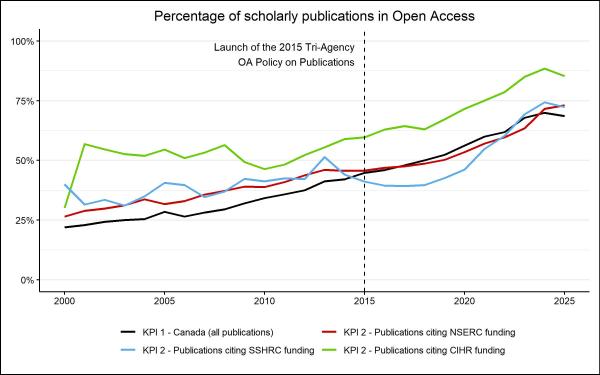
The Agencies have identified key performance indicators (KPIs) for the revised Policy and commit to publicly tracking these, using open data sources. The KPIs and current baselines are provided below.
- KPI 1: Proportion of Canadian (co)authored peer-reviewed journal articles that are available in open access
- KPI 2: Proportion of agency-funded peer-reviewed journal articles that are available in open access
-
Long description: Percentage of scholarly publications in open access, 2000 to 2025
This line chart shows the percentage of peer-reviewed scholarly publications available in open access between 2000 and 2025. One line represents all publications with at least one author with a Canadian affiliation, and three other lines each represent publications citing funding from one of the three federal research funding agencies: Canadian Institutes of Health Research (CIHR), Natural Sciences and Engineering Research Council of Canada (NSERC) or Social Sciences and Humanities Research Council (SSHRC). A dashed vertical line marks the launch of the Tri-Agency Open Access Policy on Publications in 2015.
Open access availability increased substantially across all four groups over the period. The percentage of publications with at least one Canadian-affiliated author that were available in open access increased to 68.6% in 2025 from 22.0% in 2000. Among publications citing funding from one of the agencies, the percentage available in open access increased to 73.0% from 26.5% for those citing NSERC funding, to 72.4% from 40% for publications citing SSHRC funding, and to 85.3% from 30.2% for publications citing CIHR funding.
After the policy was introduced in 2015, open access availability continued to increase across all four groups, although growth patterns varied. Publications citing CIHR funding had the highest rate of open access availability throughout most of the period, reaching 85.3% in 2025. Publications citing SSHRC funding showed more year-to-year variation in open access rates than the other three groups, peaking at 51.4% in 2013, then declining before increasing sharply after 2020.
By 2025, all four groups exceeded 68%.
In conjunction, the Agencies will improve the ability to monitor OA publishing through the implementation of persistent identifiers and clearer reporting. These initiatives will also help ensure that publicly funded research is appropriately identified, discoverable and widely disseminated.
The Agencies expect these actions will contribute to reducing pressure on researchers to publish in high-cost venues, empowering them to choose sustainable OA pathways, and embedding openness as a core principle of Canadian scholarship.