
What is the I-STEM Cluster?
A federal inter-departmental and agency team launched in December 2019 to inform and enhance federal policies, programs, and activities related to STEM (Science, Technology, Engineering, and Mathematics).
Indigenous Peoples have long advocated for a more coordinated approach across government to wholistically address their interrelated priorities while reducing consultation fatigue.
A cluster approach was recommended by the Deputy Ministers Task Force on Indigenous Reconciliation (July 2019) to reduce duplication, break down silos inside government, and enhance effectiveness while co-developing solutions with Indigenous partners.
I-STEM departments and Indigenous Peoples share an inherent connection and commitment to environmental stewardship. Indigenous approaches to stewardship are grounded in distinct knowledge systems, methodologies, and technologies.
What we do
The I-STEM Cluster works collaboratively to:
- Foster long-term and reciprocal relationships with Indigenous partners;
- Work within the federal STEM space to educate and train public servants; and
- Attract, nurture and retain Indigenous talent in STEM fields.
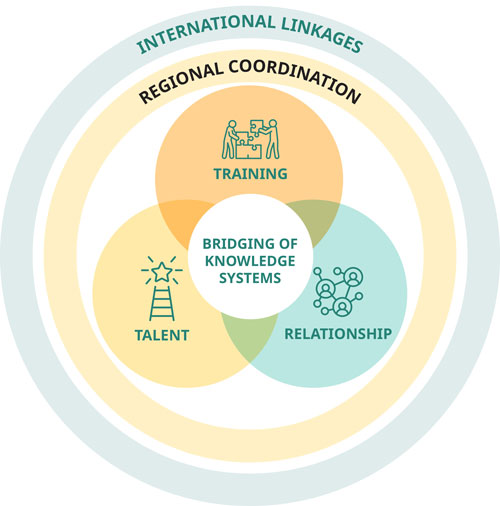
A foundational focus on relationships, training, and talent provides the platform for bridging of Western and Indigenous knowledge systems.
The Indigenous STEM Cluster works to create an ethical space where diverse voices and perspectives are heard, recognized, and uplifted. It also helps these voices be heard and valued collectively in policy and decision-making processes.
The Cluster also attempts to address common uncertainties associated with building relationships, to build the trust needed to truly co-develop initiatives.
The Cluster pilots new approaches to inform larger scale efforts of member departments and agencies.
Figure 1 - Bridging of Knowledge Systems
-
Figure 1 - Text version
This image highlights the key elements of the Interdepartmental Indigenous Science, Technology, Engineering and Mathematics (I-STEM) Cluster strategy.
Advancement in the three themes of training, talent, and relationships which in this diagram are shown as circles which overlap centrally , works to uphold the understanding and respect of Indigenous knowledge systems in contribution towards federal science, science policy, research and technology, and development and transfer.
The fourth key theme of bridging Indigenous knowledge with existing western science systems and structures is shown in the image as a circle centrally within the overlap of the previous three. Underpinning these themes is a focus on both regional coordination and international linkages, shown as hoops encircling the four key themes.
Who We Are?
The I-STEM Cluster includes 15 Federal governmental departments and agencies.
- Agriculture and Agri-Food Canada (Host and Co-Chair)
- Department of Fisheries and Oceans (Co-Chair)
- Canadian Food Inspection Agency
- Canadian Space Agency
- Environment and Climate Change Canada
- Health Canada
- Ingenium
- Knowledge Circle for Indigenous Inclusion
- National Research Council
- Natural Resources Canada
- Natural Science and Engineering Research Council of Canada
- Office of the Chief Science Advisor
- Parks Canada
- Public Health Agency of Canada
- Public Services and Procurement Canada
The I-STEM Cluster is honoured to be guided, supported and inspired in its work by an Indigenous Advisory Circle.
Reports
- I-STEM Cluster Report (July 2025)
Associated Links
- Canada’s Federal Interdepartmental Indigenous STEM Cluster – A Force for Cooperation, Empowerment, and Reconciliation [Ingeniumcanada.org]
- The science of reconciliation! Bridging Indigenous knowledge with agricultural science [podcast, Agriculture.Canada.ca]
- Indigenous science [Canada.ca]
- Truth and Reconciliation Commission of Canada’s 6-volume final report, including its 94 Calls to Action, in December 2015;
- Clerk of the Privy Council’s Call to Action on anti-racism, equity and inclusion in the federal public service in January 2021 and the follow-up Call to Action forward direction message to deputies in May 2023;
- United Nations Declaration on the Rights of Indigenous Peoples Act receiving Royal Assent and coming into force in Canada in June 2021; and
- Directive to all ministers in their mandate letters to move faster along the path of reconciliation with Indigenous peoples.
Contact Us
For more information, please contact the I-STEM Secretariat.