
Interdepartmental Indigenous Science, Technology, Engineering & Mathematics (I-STEM) Cluster
July 2025

Download the alternative format
(PDF format, 4.54 MB, 36 pages)
Organization: I-STEM Cluster
Published: 2025
Table of Contents
- Executive Summary
- I-STEM: from Conception to Inception
- Support for the Growth of I-STEM
- I-STEM Growth Cycle: Sprout to Flowering Tree
- The I-STEM Cluster – Creating Trusting Partnerships
- Support to Indigenous Organizations Innovating in STEM
- Creating Ethical and Safe Work Spaces for Indigenous Employees
- Creating Ethical and Safe Work Spaces for Indigenous Students
- Enhancing OCAP® training and tools - a collaboration with FNIGC
- International Collaborations and Partnerships - New Zealand, United Kingdom & South Africa
- Signal Fire Film
- Canadian Science Policy Conference Panel Discussions
- The I-STEM Cluster – Internal Collaborative Successes
- Indigenous Science Workshops and Training for Federal STEM Professionals
- Federal Policies, Frameworks and Guidelines - Shared Toolkits and Resources
- Recruitment, Retention, and Talent Promotion
- Bridging Knowledge in Federal Science Policies
- Interdepartmental Knowledge Sharing
- Indigenous Science Units
- Intentionally Cultivating Strength-Based Growth
Executive Summary
Indigenous Peoples have long advocated for a more coordinated approach across government to wholistically address their interrelated priorities while reducing consultation fatigue. Recognizing the clear need to move from Indigenous Peoples’ exclusion to self-determination in science, technology, engineering and mathematics (STEM) research, the interdepartmental Indigenous STEM Cluster (“the Cluster” or “I-STEM”) emerged in 2019. Since then, it has generated an immense amount of interest from federal departments, agencies, and diverse organizations committed to advancing Indigenous reconciliation at the vibrant intersections of STEM and Indigenous knowledge systems. The value proposition of I-STEM is that, by combining resources, knowledge, experiences, approaches, and efforts, departments and agencies will collectively learn faster and become better partners for co-developed and Indigenous-led STEM research. From four initial departments to the current membership of 15, the Cluster’s ability to forge connections with internal and external partners has led to a rapid ascent in the Cluster’s reputation and reach.
The main objectives of the Cluster are intricately interrelated and mutually reinforcing:
- Enhance intercultural competencies in the federal public service,
- Nurture Indigenous STEM talent; and,
- Build and strengthen relationships between federal STEM and Indigenous Peoples.
In the pursuit of these transformative objectives, the I-STEM Cluster has achieved inspiring accomplishments in the way that it carries out its work: co-development, collaboration, and cooperation.
The Cluster’s collaborative approach envisions a future founded on mutual respect, understanding, and collective growth. The Cluster passionately amplifies the voices and contributions of Indigenous Peoples in STEM, fostering an atmosphere where Indigenous science and knowledge systems exert transformative influence on research design and outcomes. Western and Indigenous STEM realms converge as dynamic tools that empower decision-making and propel innovations to bolster self-determination in STEM pursuits.
This vision is not without its challenges, however. Implementing the "cluster" concept involved overcoming obstacles in establishing effective cross-departmental collaboration within the federal government's large science-based departments and agencies. The dedication, innovation, and trust within the Cluster team have been essential in addressing these challenges. For example, the capacity of I-STEM faced significant hurdles, particularly in staffing levels of secondees within the Cluster. Lessons learned include the positive impact of converting operating dollars to salaries, providing a more stable and committed workforce. Member department participation also varied, highlighting the importance of experienced and dedicated representatives. The overreliance on a few highly in-demand Indigenous STEM personnel is a continued challenge, emphasizing the need to create a network of Indigenous Scholars to diversify talent and distribute workload. Addressing burnout and turnover among Indigenous public servants is crucial, recognizing their unique challenges and utilizing a personalized and culturally sensitive approach. Despite the significant progress of I-STEM thus far, ongoing and intentional work is needed to address these challenges and enhance the effectiveness of I-STEM's goals as we move to the next iteration.
To begin addressing the systemic lack of trust between Indigenous Peoples and the Government of Canada, including internally with Indigenous employees, the Cluster has co-developed and iteratively refined an innovative, participatory I-STEM workshop series and associated curriculum. The curriculum progresses from understanding and acknowledging the truth of colonization to its science, and its impacts on Indigenous Peoples and their knowledge systems, so that learners will be equipped to contribute to reconciliation through research. This experiential "learning-by-doing" approach extends to the collective work of I-STEM Cluster employees, who collaboratively develop and deliver collective work plan activities and coordinate towards objectives that respond to our shared priorities across member departments, ensuring a unified vision for advancing Indigenous self-determination and equitable outcomes from STEM activities. The Cluster also builds and strengthens trust and relationships with Indigenous research organizations on behalf of all federal STEM.
In the I-STEM Cluster, Indigenous and allied STEM professionals, scholars, policy analysts and leaders come together to create an ethical space where they can co-develop a path forward, including tools, approaches, and recommendations, to equitably support and bridge Western and Indigenous STEM. They collectively navigate a path towards a future where the reimagination of how environmental sustainability, cultural revitalization, and socioeconomic development are undertaken becomes a guiding principle. The strong interest in the Cluster, both internal and external, along with ever-growing participation, continues to validate the I-STEM model and approach. This ongoing transformative journey aims to maximize benefits for Indigenous and non-Indigenous communities, shaping a landscape where collaboration and Indigenous leadership in STEM stand as the bedrock of a collective future.
I-STEM: from Conception to Inception
Meeting the Challenge
Indigenous Peoples have long advocated for a more coordinated approach across government to wholistically address their interrelated research priorities while simultaneously reducing consultation fatigue. Similarly, Indigenous employees scattered throughout the federal government have worked for decades ‒tirelessly, courageously, and often alone ‒ to leverage the vast resources and potential of the government to address the needs of their home communities and build a better, brighter future for all Indigenous and non-Indigenous people within Canada to enjoy.
Indigenous science, technology, engineering and mathematics (STEM) has been practiced in the Americas far longer than Western science; recent estimates are that Indigenous STEM has been practiced here for tens of thousands of years, while Western science is only 500 years old itself. Indigenous STEM is testable, replicable, and peer-reviewed, just like Western STEM. Indigenous Peoples have developed, refined, maintained, and transmitted knowledge systems based on the ecosystems, landscapes, topographies, species, and climates found in Canada since time immemorial, despite many deliberate efforts to destroy these systems, their practitioners, and their cultures. Elders, Knowledge Keepers, and practitioners (e.g., hunters, harvesters, and fishers) also travel and share information just like Western scientists. There is immense potential for federal resources (through funding and expertise) to support Indigenous knowledge systems and scientists.
The federal government approach has categorized and split much of the natural world into separate entities and jurisdictions, managed by different federal departments, each focusing on its own specific areas like agriculture, fisheries, mining, forestry, public health, space, or the environment. This approach poses difficulties because Indigenous research often encompassed multiple sectors, requiring a more wholistic approach.
For instance, Agriculture and Agri-Food Canada () has jurisdiction for land-based plant and domestic animal production, whereas Environment and Climate Change Canada (ECCC) deals with migratory animals and wild-harvested foods with the exception of those from the forest, which fall under Natural Resources Canada (NRCan). Fisheries and Oceans Canada (DFO) is responsible for managing Canada’s fisheries and ocean resources until they are processed as food, after which AAFC or the Canadian Food Inspection Agency (CFIA) would have jurisdiction again. ECCC, however, has jurisdiction over the quality of the water that the fish occupy, but DFO is responsible for habitat protection. This fragmented system has led to consultation fatigue for Indigenous research partners, who had to navigate through multiple departments to address their priorities.
A “cluster” approach, as recommended by the Deputy Ministers Task Force on Reconciliation (July 2019), reduces duplication, breaks down silos inside government, and enhances effectiveness while co-developing solutions with Indigenous partners. In December 2019, the interdepartmental Indigenous STEM (I-STEM) Cluster was established, to better inform and enhance Canadian federal policies, programs, and activities within STEM disciplines. This initiative aims to increase support for Indigenous priorities in environmental stewardship and research.
Since its inception, the I-STEM Cluster has rapidly expanded from an initial four departments to 15 federal departments and agencies. This overwhelming interest demonstrates a strong desire by departments to take a collective approach to supporting Indigenous STEM, co-developing approaches with Indigenous Peoples, and to share in lessons learned as they arise. For example, while many federal departments and agencies have developed approaches to allow for greater and more meaningful participation and leadership by Indigenous Peoples in STEM, these successes are not frequently communicated across the federal public service to enable other departments and agencies to model their approaches.
A mechanism, such as the I-STEM Cluster, is required to share the successes departments have had so that they can be quickly and efficiently replicated and adapted by other departments and agencies. Additionally, all departments and agencies share common challenges and opportunities with respect to recruitment, retention, and advancement of talent, cultural competency training, inclusive policies and programs, data and intellectual property, research ethics, relationship-building, engagement, co-development, and more. Pooling our resources and efforts around these shared objectives will not only be more efficient than working alone, it will also reduce consultation fatigue for Indigenous partners while providing consistent guidance and approaches across departments and agencies. The I-STEM Cluster provides a space for collective, cross-departmental learning and coordination, and encourages the adoption and consistency of promising practices across federal STEM.
Perhaps most importantly of all, the Cluster has created a safe, nurturing environment for Indigenous employees and their allies who are working in an emotionally laden area. By working together to develop and deliver collective work plan objectives, the I-STEM Cluster is “learning by doing” so that the innovative practices piloted in I-STEM, and co-developed with our network of Indigenous partners, can then be mainstreamed into the Cluster’s member departments and agencies.
Examples of Indigenous knowledge systems and scientists:
- Use of fire to maintain grazing habitat for wild-harvested animals
- Use of fire to maintain food-producing ecosystems, such as the Garry Oak ecosystem and associated Camas bulbs
- Management of permacultures, food forests, and companion planting such as the Three Sisters and Four Sisters
- Harvesting and stewardship of bison, and knowledge of bison-facilitated ecosystems
- Knowledge of endemic plant and animal food species well-suited to local climates (climate change mitigation and adaptation)
- Knowledge of cultivation and stewardship techniques locally adapted and most suitable for the ecosystems found in Canada
- Distinct worldviews, values, methodologies and knowledge systems leading to different research priorities, questions, and lines of inquiry than Western science.
The Principles Guiding Our Shared Work
The I-STEM Cluster operates under key principles to help shape its structure, approach and work:
- Cooperation with other departments and agencies;
- Collaboration between I-STEM members departments and agencies;
- Co-development with Indigenous partners (including external partners, employees, and the Advisory Circle); and
- Respect and amplify Indigenous knowledges, leadership, and rights including self-determination.
These principles guide the Cluster so that the following objectives can be realized:
- Enhance intercultural competencies in the federal public service;
- Nurture Indigenous STEM talent; and
- Build and strengthen relationships between federal STEM and Indigenous Peoples.
Adopting collaborative approaches brings benefits to both Indigenous Peoples and I-STEM Cluster member departments and agencies. For Indigenous Peoples, it means their voices are heard, their rights are respected, and their perspectives are integrated into policy and decision-making processes. It allows them to maintain and revitalize their cultural practices, preserve traditional lands, and protect their natural resources in ways that are consistent with their values and traditions. For the federal government, individual departments or agencies are positioned to better succeed in relationship-building and co-development as invaluable insights and innovative solutions will emerge that may have otherwise been overlooked. This collaboration creates an environment that enables Indigenous STEM concepts, ideas and values to equitably interact and drive evidence-based decision-making in a science system that to date has been created for Western notions of what constitutes science. Cooperation, collaboration and co-development leads to more informed, inclusive, and sustainable policies and practices and improved decision-making, benefiting not only Indigenous communities but also Canadian society as a whole.
I-STEM Themes
Since 2019, the Cluster has embarked on inspiring initiatives that align with our core themes and pushed the boundaries of innovation and collaboration. Working collectively across 15 departments and agencies creates momentum, leverages the strengths and experiences to avoid “re-inventing the wheel” and leads to effective and efficient use of resources. One of the Cluster’s core approaches is to enable respectful reciprocal exchange of knowledge and experiences to demonstrate by example best practices and approaches, which enhances our ability to work both individually and collectively towards our goals. A second approach used by the Cluster is “learning-by-doing”: starting with a pilot of new or experimental approaches, learning, adjusting, and finally sharing lessons learned. Advancement in the three themes of training, talent, and relationships works to uphold the understanding and respect of Indigenous knowledge systems in contribution towards federal science, science policy, research and technology, and development and transfer, including the fourth key theme of bridging Indigenous knowledge with existing Western science systems and structures.
Recognizing relationships as foundational, the importance of truth before reconciliation is evident, necessitating transparent conversations. To build meaningful relationships, training for public servants is pivotal. This training serves a dual purpose: enhancing intercultural competencies for effective collaboration with Indigenous partners and creating culturally safe environments within departments. Simultaneously, the focus on talent emphasizes the need for robust support in both Indigenous and Western STEM. This wholistic approach ensures not only the cultivation of Indigenous talent within federal STEM but also the empowerment of communities through enhanced STEM capacity and external partnerships. Through this interconnected framework of relationships, training, and talent, a pathway is laid for a more collaborative, inclusive, and sustainable future.
Underpinning these four primary themes are two cross-cutting foundational principles:
- Understanding and reflecting regional distinctiveness within our Nation-to-nation, Inuit-Crown, government-to-government relationships; and,
- Building synergistically beneficial relationships with Indigenous communities and leadership internationally.
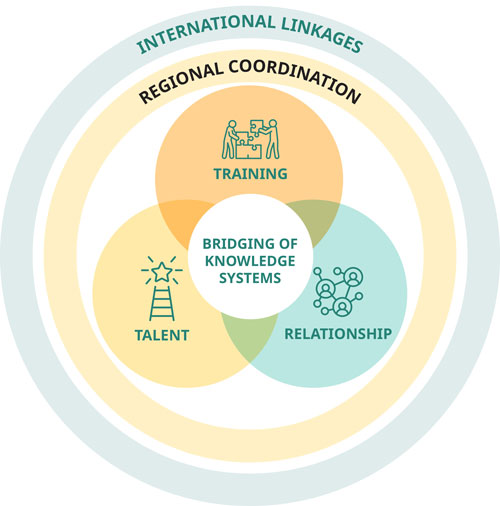
Figure 1: This image highlights the key themes of the I-STEM Cluster. The three central themes of training, talent, and relationships are shown as circles which overlap centrally. The fourth key theme of bridging knowledge systems is shown in the image as a circle centrally within the overlap of the previous three. Underpinning these themes is a focus on both regional coordination and international linkages, shown as hoops encircling the four themes.
-
Figure 1 - Text version
This image highlights the key elements of the Interdepartmental Indigenous Science, Technology, Engineering and Mathematics (I-STEM) Cluster strategy.
Advancement in the three themes of training, talent, and relationships which in this diagram are shown as circles which overlap centrally , works to uphold the understanding and respect of Indigenous knowledge systems in contribution towards federal science, science policy, research and technology, and development and transfer.
The fourth key theme of bridging Indigenous knowledge with existing western science systems and structures is shown in the image as a circle centrally within the overlap of the previous three. Underpinning these themes is a focus on both regional coordination and international linkages, shown as hoops encircling the four key themes.
Through a “learning-by-doing” approach, the Cluster is building skills needed for a transition to science co-development:
- Truthfulness and Trust
- Cross-Cultural Competency
- Knowledge Diplomacy
- Cognitive Knowledge Systems Load Management
- Novel Thinking and Understanding
- Relational Designing
- Distinctions-Based Approach to Engagement
Training for public servants has been a crucial component of the Cluster’s success in advancing our goals. We need to acknowledge the truth before we can get to reconciliation, and we cannot do this without cultural awareness and literacy, as well as intercultural competency development. The I-STEM Cluster has collaboratively built and iteratively refined a learning continuum for public servants in STEM that begins to socialize the key values and principles by which a new approach to STEM in Canada can be built. This training features Indigenous voices (both internal and external to government), expands networks, creates new collaborations, and allows learners to continue their learning journey by eventually becoming teachers to increase sustainability. STEM professionals are increasingly better informed and equipped to engage ethically and co-develop science with Indigenous people.
However, despite greater awareness of many challenges (consultation fatigue, extraneous and absent reporting, funding application barriers, generalized low availability of capacity), many of these problems persist. As such, the Cluster is working collectively to build individual, community and organizational level awareness and understanding of Indigenous realities to enable the building of equitable STEM systems. Awareness is the first step in the continuum, followed by literacy, then intercultural competency.
Since 2019, the Cluster has facilitated workshops and collaborative activities to provide training and competency building opportunities for our staff and federal learners in the I-STEM departments. These training initiatives are not simply events; they are wholistic collaborations that achieve I-STEM objectives across all thematic areas, not just Training. These transformative initiatives represent I-STEM’s commitment to continuous learning and growth, and to the transformation of research and relationships. Through these efforts, we have empowered federal employees within our member departments and agencies with the necessary knowledge and resources to navigate the complexities of Indigenous science and promote inclusive practices.
Talent is the next I-STEM theme; supporting Indigenous STEM talent wherever it may be ‒whether internal or external to federal STEM, youth, students, seasoned employees, and everything in between. To grow capacity within federal STEM to engage with Indigenous STEM practitioners, develop Indigenous policy, and co-develop research projects, there is a need not just to train existing public servants, but also to employ more Indigenous experts within the departments. This is accomplished, in part, by improving both the support and opportunities for Indigenous people working in STEM and in STEM organizations. Additionally, supporting a larger pool of Indigenous STEM talent in Canada generally will reduce our collective overreliance on a few Indigenous STEM personnel, and improve outcomes from both an organizational staffing perspective, as well as an Indigenous employee satisfaction perspective. This is especially important as departmental success continues to rely on Indigenous researchers and Indigenous collaboration. STEM training (both conventional and land-based) and education systems need to be enhanced in order to achieve equitable outcomes for Indigenous communities and youth. This relates back to our first theme of Training – by making federal departments and agencies more culturally safe and welcoming for Indigenous people, and by prioritizing the experience of the individual over departmental hiring objectives, we can collectively create an environment for Indigenous STEM talent to thrive and flourish.
Distinct strategies that enhance engagement of Indigenous people with science across all age groups (K-12, colleges, university, mature students, continuing education, etc.) need to be in place to build science capacity within community and make available Indigenous science capacity for within and working with federal departments. The building of Indigenous science leadership in both community and the federal public service will require new, collaborative and transformative approaches, with a lens on considerations that have historically been neglected across Canada. Some of the initiatives by the Cluster that have showcased their “learning-by-doing” approach and notable achievements are highlighted below.
- The Cluster has organized Indigenous science student days, providing valuable opportunities for learning and networking. In addition to reaching students, these events are also about creating internal momentum and change within the public service, creating a community of practice, and piloting innovative approaches.
- Indigenous employees have achieved career advancement by demonstrating their talent and gaining exposure to senior hiring managers in our cross-departmental workshops.
- The Cluster also takes a collective and culturally appropriate approach to hiring Indigenous students in STEM fields and encourages them to showcase their work within the Cluster, providing a bridge to potential career paths that are the right fit for the individual.
Relationships have been a central theme in the Cluster’s efforts to promote Indigenous leadership and, bridge knowledge systems. Reconciliation demands a commitment to unveiling and understanding the truth of lived experiences and systemic misdeeds. It is only through open and honest conversations that the barriers that divide and suppress can be overcome. Thus, prioritizing the establishment of trust and fostering meaningful relationships must precede any attempts at reconciliation. By doing so, the essential groundwork for collaborative efforts that acknowledge the past, honor the present, and pave the way for a more harmonious future are laid.
The importance of relationship-building is increasingly valued across research fields and federal departments as the importance of contributing to Indigenous self-determination and rights continue to become more widely understood as requisite for impactful co-developed research. However, current levels of resourcing or current program designs often limit the ability to do so in an appropriate manner. Enhancing the ability of current programs or projects to develop, maintain, and strengthen trusting and responsible research relationships with communities is vital for reconciliation.
Historically, relationships between researchers and communities begin, end, and begin anew. This not only leads to frustration and loss of trust, but severely hampers the ability to make meaningful progress on priorities both Indigenous and non-Indigenous. Trust and relationship-building take place in local contexts, through processes that are locally defined, necessitating skills, tools, and resources that are locally responsive. Indigenous approaches need to be respected and recognized as equally valid to Western STEM approaches, to ensure consistent and appropriate communication, support, and resourcing of relationships that are already in place, and those that are being created.
Some of the Cluster’s key achievements relating to relationships are highlighted here.
- The Cluster has laid the framework to build strong relationships with Indigenous communities, organizations, partners, Elders and Knowledge Keepers.
- Through workshops, panel discussions, and collaborative initiatives, the Cluster has recognized and upheld principles (e.g., ethical space and truth before reconciliation) needed to create meaningful connections and partnerships.
- The Cluster has also established strong international linkages with counterparts in Aotearoa New Zealand, the United Kingdom, South Africa, and the United States, and is exploring opportunities to facilitate international collaboration on Indigenous participation and governance in STEM, for example, through personnel exchanges and the co-development of STEM policy and Indigenous-Indigenous research protocols.
- The Cluster has facilitated relationship building between departments and agencies. Internal relationship-building has been central to I-STEM’s success as the network of internal communication has broadened with barriers being reduced.
Bridging of Knowledge Systems refers to the intentional and constructive collaboration of diverse ways of understanding, interpreting, and generating knowledge. It recognizes and values the unique perspectives, insights, and wisdom embedded within different cultural, historical, and experiential contexts. This can be achieved by building partnerships, advancing talent and providing training in order to elevate the recognition of the equivalency of Indigenous STEM and Western STEM. Whether bridging knowledge systems or providing opportunity for knowledge systems on distinct parallel trajectories, resources and structures are being promoted by the Cluster in order to see, value, recognize, and, only with appropriate care and permissions, use various ways of knowing across the entire spectrum of evidence-based decision-making.
Science, whether Indigenous or Western, is a culture unto itself. As such, the Cluster is working to build capacity across all groups engaged in the scientific process to not only further develop their own knowledge systems, but to also drive greater capacity to ethically interact with Indigenous knowledge systems as well as find the appropriate intersections where they can reciprocally combine. The Cluster has provided guidance and advice from an Indigenous Science lens to many key departmental and cross-departmental initiatives including:
- The Federal Open Science policy;
- Federal Scientific Integrity Policy guidelines;
- The Global Biodiversity Framework; and
- Health Canada’s Anti-Racism in Science Action Plan.
Support for the Growth of I-STEM
Governance Model
The governance of I-STEM is composed of four key bodies, each playing a distinct role in the initiative's success. The I-STEM Assistant Deputy Minister (ADM) Governance Committee and its subcommittees form the core decision-making body, overseeing high-level strategic direction and commitment, and ensuring alignment with departmental priorities. The I-STEM Director/Director General (DG) Forum provides a platform for executive leadership to mobilize departmental resources, collaborate and share insights, and foster cohesive teams across and within participating departments and agencies. The I-STEM Advisory Circle offers external Indigenous STEM perspectives and guidance, enriching the initiative's strategy with diverse expertise. Finally, the I-STEM Secretariat serves as the operational backbone, facilitating interdepartmental cooperation and communication, supporting governance bodies, coordinating work plan initiatives, and managing essential administrative processes. As I-STEM evolved, these bodies have collectively met the dynamic challenges and opportunities, contributing to the initiative's ongoing success.

Figure 2:Diagram of the I-STEM Cluster governance structure showing a red circle in the center representing the I-STEM Cluster Interdepartmental Team, with reciprocal arrows off the top, bottom, and both sides. These arrows each lead to a teal circle with the labels I-STEM Advisory Circle (left), I-STEM Director/DG Forum (bottom), I-STEM Cluster Secretariat (right), and the I-STEM Cluster ADM governance committee and sub-committees (top). The arrow to the top circle has a distinction for the I-STEM ADM host and co-chair (AAFC) and the I-STEM ADM co-chair (DFO). The 4 teal circles are all connected by a light yellow ring encompassing them.
-
Figure 2 - Text version
Diagram of the I-STEM Cluster governance structure showing a red circle in the center representing the I-STEM Cluster Interdepartmental Team, with reciprocal arrows off the top, bottom, and both sides. These arrows each lead to a teal circle with the labels I-STEM Advisory Circle (left), I-STEM Director/DG Forum (bottom), I-STEM Cluster Secretariat (right), and the I-STEM Cluster ADM governance committee and sub-committees (top). The arrow to the top circle has a distinction for the I-STEM ADM host and co-chair (AAFC) and the I-STEM ADM co-chair (DFO). The 4 teal circles are all connected by a light yellow ring encompassing them.
Advisory Circle
A main priority in the initial years of the I-STEM Cluster’s growth was to initiate an Advisory Circle: a group of Indigenous scholars, professionals, Elders, Knowledge Keepers, and Knowledge Holders willing to share their experience and expertise with federal STEM. The conceptualization and formation of the Advisory Circle was undertaken as a collaborative effort amongst the Cluster’s governance, with strong support and visionary leadership from ) AAFC, DFO, Public Services and Procurement Canada (PSPC), and the Natural Sciences and Engineering Research Council of Canada (NSERC) in implementing a shared vision of creating a reciprocal, knowledge-sharing, relationship-based space.
The I-STEM Advisory Circle is a body that provides guidance and advice to federal STEM leaders aimed at mobilizing the federal STEM system. The intention of the Circle is to build relationships and trust in order to co-develop the I-STEM Cluster work plan and future direction of the I-STEM strategy within a reciprocal, knowledge-sharing, relationship-based environment that creates and holds space for the full inclusion of Indigenous worldviews, knowledge systems, teachings, values, and oral traditions within federal STEM.
The Advisory Circle and federal STEM leaders held their inaugural face-to-face meeting in December 2022. Here they began building relationships and trust through the sharing of perspectives. These relationships are essential to help shape a path forward where federal STEM researchers, leaders, and organizations can equitably co-develop with First Nations, Métis Nation, and Inuit, research priorities, projects, and activities. This approach signifies a commitment to guaranteeing the realization that space for federal STEM disciplines and Indigenous knowledge systems are created to work alongside each other to create and co-create new knowledge both within and between multiple systems and ways of knowing.
Some initial guiding principles related to the space, the process, and the values were developed by the Advisory Circle and are pivotal to all approaches and initiatives carried out by the I-STEM Cluster.
The Space:
The creation of a safe space is essential to begin these types of conversations.
The Process:
The emphasis on the process (the "how" rather than the "what") requires an investment of time, aligning with the ethos of reconciliation. As we engage in the co-developed and co-created process of reconciliation, where the destination is not pre-defined, our focus lies in agreeing on the collaborative approach – the "how" – to navigate this path together. This emphasis on process is central to our collaboration with the Advisory Circle, where we work to establish the principles and approaches for achieving our shared objectives of building relationships and an equitable science system. It is necessary and expected in this context.
The Values:
Core concepts such as place-based, community-led, multi-generational, self-determination and rights-based are general values that need to be considered in the creation of principles for any initiative focused on Indigenous science strategic policy-making. The inherently broad scope of federal STEM initiatives often results in a loss of effectiveness when applied at the local level. By collaboratively working to co-create new approaches grounded in these core Indigenous values, there is a substantial opportunity to enhance the impact of federal STEM initiatives and concurrently foster increased public trust in their outcomes. This shift towards localized, community-driven strategies aligns with the specific needs and aspirations of Indigenous communities, thus addressing the current limitations and striving for more impactful outcomes.
I-STEM Growth Cycle: Sprout to Flowering Tree
The Sprout
The story of the I-STEM Cluster begins with humble origins. In its nascent stage, four forward-thinking departments and agencies (AAFC, DFO, ECCC, and NRCan) planted the seeds of collaboration, driven by a shared commitment to amplify the impact of federal science by working and coordinating across departments to more wholistically support the understanding and implementation of Indigenous-led initiatives in environmental stewardship and research. These departments recognized their own strengths and gaps, and drove the opportunity for synergy, laying the groundwork for what would evolve into a dynamic interdepartmental collaboration. The sprout emerged as the I-STEM Cluster, setting the stage for a transformative journey ahead.
The Sapling
As the I-STEM Cluster took root, its vitality attracted an ever-growing number of participating departments and agencies, surpassing the expectations of its founding departments. This phase witnessed a surge in interest and commitment, with an eventual 15 departments and agencies joining the collective effort. This pooling of ideas and resources allows for harmonized initiatives and an overall optimization of time and financial contribution. However, the rapid growth brought challenges as the demand for action outpaced the initial capacity of the Secretariat. An abundance of financial resources but a shortfall in personnel presented the Cluster with a unique challenge – how to efficiently harness this momentum and departmental commitments to ensure that every dollar contributed to meaningful outcomes. The sapling stage underscored the need for strategic decision-making and a scalable structure to fully realize the potential of the I-STEM vision.
The Sapling to Tree Transition
In response to the challenges faced during the earlier phase, the I-STEM Cluster took a decisive turn in January 2022, investing its financial resources into sustained capacity. The decision – informed by discussion with ADMs and the Advisory Circle - was made to invest in a core Secretariat, transforming the Cluster into a more mature and robust entity. This marked a pivotal moment in the Cluster's evolution, as the original vision of a Secretariat for a more coordinated I-STEM governance team came closer to fulfillment. A team of Indigenous talent and allies coalesced, providing more power to propel the work plan forward and strategically deploy resources for a more efficient impact. However, the planned expansion should have resulted in a full-time secondment from each member department and agency to realize this potential, which has yet to come to fruition. This strategy will continue to enhance the effectiveness of engagement between Indigenous organizations and federal STEM initiatives, minimizing resources spent on either end while resulting in increased output and overall benefit. I-STEM is becoming a trusted partner on behalf of all federal STEM that external Indigenous partners are keen to engage with. The sapling is maturing into a flowering tree, symbolizing not just growth, but a blossoming of collaborative potential in achieving the I-STEM Cluster's overarching objectives.

Figure 3: This image highlights the key themes of the I-STEM Cluster. The three central themes of training, talent, and relationships are shown as circles which overlap centrally. The design uses icons to represent each focus area. The fourth key theme of bridging knowledge systems is shown in the image as a circle centrally within the overlap of the previous three. Underpinning these themes is a focus on both regional coordination and international linkages, shown as hoops encircling the four themes.
-
Figure 3 - Text version
This image highlights the key themes of the I-STEM Cluster. The three central themes of training, talent, and relationships are shown as circles which overlap centrally. The design uses icons to represent each focus area. The fourth key theme of bridging knowledge systems is shown in the image as a circle centrally within the overlap of the previous three. Underpinning these themes is a focus on both regional coordination and international linkages, shown as hoops encircling the four themes.
Surrounding the image is a person-shaped icon that represents each of the 15 member departments and agencies with their accompanying label including Agriculture & Agri-Food Canada (Host), Fisheries & Oceans Canada (Co-Chair), Public Health Agency of Canada, Canadian Food Inspection Agency, Canadian Space Agency, Environment and Climate Change Canada, Health Canada, Ingenium, Knowledge Circle for Indigenous Inclusion, National Research Council Canada, Natural Resources Canada, Natural Sciences and Engineering Research Council of Canada, Office of the Chief Science Advisor, Parks Canada, and Public Services and Procurement Canada.
The I-STEM Cluster – Creating Trusting Partnerships
The I-STEM Cluster is a trusted partner in the STEM space for the Government of Canada, for both internal employees and external partners. The Cluster works by creating an ethical space where diverse voices and perspectives are heard, recognized, uplifted, and valued collectively in policy and decision-making processes.
I-STEM has worked to address common uncertainties across departments and agencies including: how to create and foster meaningful relationships, who to talk to, where to start, how to build trust, and how to support or truly co-develop initiatives. The interest to work with and draw benefits from the Cluster remains high and is continually growing.
Support to Indigenous Organizations Innovating in STEM
The Cluster has been active in building relationships with Indigenous partner organizations and individuals who are innovating in STEM. Cluster members have participated in event planning committees, actively creating space for Indigenous innovators, Elders, students and others to inspire and influence. Participation, support and sponsorship in these initiatives have built, fostered and deepened relationships between and with Indigenous scientists and paved the way for strengthening self-determination in Indigenous STEM activities and practices.
At the 2022 inaugural Turtle Island Indigenous Science Conference in Winnipeg, Manitoba, Cluster members were active in the planning committee, and participated throughout the sessions, learning about the Indigenous scientific legacy and the value of the application of multiple worldviews to modern science today. Cluster members expanded their networks with everyone from students to Elders, and learned about how scientific knowledge is embedded in Indigenous languages, the importance of traditional medicine and health, Indigenous engagement with the land and the environment, and novel STEM education approaches that include Indigenous ways of knowing.
The Indigenous Centre for Cumulative Effects held it’s first in-person conference in Ottawa, Ontario in 2023. Cluster members were there to network with speakers who were sharing their knowledge on cumulative effects assessment, management, and monitoring, and how ground-breaking initiatives are helping Indigenous communities to strengthen their capacity to build stronger communities.
At the 2023 Kluane Research Summit in Burwash Landing, Yukon Territory, Kluane people were brought together to highlight co-developed programs designed to better understand relationships to and between the land, water and communities, both human and animal in their area. Cluster members were able to experience community-level respectful knowledge sharing practices in an open and honest exchange.
At the 2023 Canadian Mountain Network Knowledge Sharing Summit in Parksville, British Columbia, the Cluster was able to connect with experts leading advancing the understanding and weaving of Indigenous and Western knowledge systems. Cluster members provided their expertise in a panel discussion, training participants in a “world café” style on beginning relationships with establishment of ethical pathways to bridging knowledge systems.
At the 2023 First Nations Education Administrators Association Annual Gathering in Winnipeg, Manitoba, Cluster members supported the overall event planning, participated in a panel discussion on STEM education for youth, and several member departments contributed towards financial sponsorship. The Cluster also hosted a booth at the conference, which further enhanced the profile of the Cluster. This gathering provided education professionals the tools and confidence to balance and connect self-determination in First Nations’ Education, provided Cluster members insight into STEM pathways for youth, and provided Cluster participants with the ability to build new relationships with organizations that have mutually supporting goals and objectives (e.g., Let’s Talk Science).
Creating Ethical and Safe Work Spaces for Indigenous Employees
Indigenous employees can often feel isolated, which perpetuates one of the major barriers to recruitment and retention of Indigenous employees. Most often they are the only Indigenous employee in a group, division or sector and are often asked to provide “expertise” in Indigenous topics voluntarily even when it is not within the scope of their work. They often face racism through unintentional comments, and can be dismissed when speaking up on difficult topics.
The I-STEM Cluster creates a space where Indigenous employees in STEM can be the majority and safely discuss both issues and innovative ideas. The Cluster actively supports advancing their work and amplifying their voices. Many Indigenous employees have formed new partnerships in STEM, advanced their career aspirations, and advanced recognition of their contributions in STEM through participating in the Cluster’s meetings, initiatives and workshops.
Creating Ethical and Safe Work Spaces for Indigenous Students
The Cluster promotes the creation of dedicated, culturally aware and safe, and tailored recruitment and retention practices. Cluster departments are expanding on lessons learned primarily from AAFC’s Indigenous Student Recruitment Initiative, and sharing experiences and best practices to prioritize positive and effective experiences for Indigenous students in STEM.
In addition, the Cluster participated in the Canadian Chapter gathering of the American Indian Science and Engineering Society (AISES) Indigenous STEM Student Society, and has formed early relationships with the Verna J. Kirkness Foundation who supports Indigenous high school students to explore university pathways.
Enhancing OCAP® training and tools - a collaboration with FNIGC
In 2020, the Cluster and the First Nations Information Governance Centre (FNIGC) initiated a collaboration to assess the breadth of scope of OCAP® training and work to create training initiatives (e.g., online modules, workshops, tools, and case studies) that are more inclusive of the considerations of scientists in the natural and environmental sciences(e.g., space sector and remote-sensing data). This type of data and information collected and used by federal scientists and science professionals is typically not well understood in the context of OCAP®.
Between 2021 and 2023, the I-STEM Cluster and FNIGC together undertook a detailed analysis to identify federal STEM professionals’ learner characteristics, the level of existing knowledge, knowledge gaps, learning expectations, and more. In collaboration with FNIGC, the Cluster has advanced consideration of natural, earth and environmental scientific considerations of OCAP® and data sovereignty from a wholistic lens. This analysis will inform and guide the next design stage of the OCAP® education delivery program which will take place in 2024 and beyond.
In addition, I-STEM coordinated on behalf of member departments and agencies to centralize communications between the 15 members with FNIGC, reducing bureaucratic fatigue and increasing a coordinated federal approach with FNIGC.
- Click here to learn more about FNIGC.
- Click here to learn more about OCAP®.
- Click here to learn more about TRC’s Call to Action #57.
International Collaborations and Partnerships - New Zealand, United Kingdom & South Africa
New Zealand Māori Delegation
Te Ara Pūtaiao (TAP), a delegation of senior Māori executives from seven New Zealand Crown Research Institutes , embarked on an international Indigenous Knowledge Exchange mission to Canada in June 2023 to share insights on fostering and increasing Indigenous participation and leadership in STEM. Drawing inspiration from New Zealand's Vision Mātauranga science policy, which mandates the integration of Māori knowledge into research and technology, TAP's visit provided valuable lessons applicable to Canada's I-STEM initiative.
During their stay, our teams sought to identify key Crown Research Institutes for potential partnerships with respective I-STEM departments, laying the groundwork for collaborative efforts between the two nations. The visit also served as an opportunity for I-STEM to establish working relationships with key senior managers within TAP, fostering follow-up discussions and potential collaborations. Ingenium's support was instrumental, hosting a delegation gathering at the Three Sisters Hall at the Canada Agriculture and Food Museum with approximately 60 guests. The event featured catering and powwow celebrations, creating a conducive environment for meaningful dialogue and relationship-building between the two Indigenous knowledge exchange initiatives.
United Kingdom Research and Innovation - Canada Research Coordinating Committee Workshop
In October 2022, Health Canada played a pivotal role in facilitating international engagement for I-STEM, culminating in the design and delivery of a session dedicated to the I-STEM Cluster at the joint United Kingdom Research and Innovation and Canada Research Coordinating Committee (CRCC) workshop on Equity, Diversity, and Inclusion . During this workshop session, the I-STEM Cluster was showcased as a compelling Canadian case study, sparking an engaging discussion among participants. The discussion revolved around strategies to enhance the equity, accessibility, and responsiveness of federal funding programs, with a specific emphasis on making the federal funding programs more equitable, accessible, and responsive to better serve Indigenous applicants.
South Africa – Canada Councils and Universities Network Summit
In April 2023, the South Africa – Canada Councils Universities Network Summit was held in Ottawa, ON and Toronto, ON, co-organized by the National Research Foundation of South Africa (NRF) and the CRCC Secretariat. The main objective of the summit was to increase collaboration in research and higher education between the two nations via multilateral meetings and activities with funding organizations, universities, and STEM-focused departments and agencies. The Agricultural Research Council (ARC) of South Africa along with NRF held a stimulating and insightful conversation with members of the I-STEM Secretariat that enabled high-level exchanges to build and reinforce international linkages and relationships, along with the ability to network with more than 60 other organizations in attendance.
Signal Fire Film
Sponsored by NRCan’s's Small-Scale Research program, the “Signal Fire” documentary translates the Towards Reconciliation: 10 Calls to Natural Scientists Working in Canada paper into a visual media format. The documentary, Signal Fire, along with the resources available on their website encourages research scientists, institutions, funders, and journal publications to unite in their efforts to elevate the standards by which we conduct, communicate, and reap the benefits of scientific research. Along with external collaborators, members from Parks Canada, NRCan, NSERC, the Office of the Chief Science Advisor (OCSA), and the I-STEM Secretariat played roles in the creation, distribution, and promotion of the film.
For more information on the Signal Fire film, click here.
To read the paper, "10 Calls to Action to Natural Scientists Working in Canada Toward Reconciliation", click here.
The 10 Calls to Action:
- Call 1: Calls on natural scientists to understand the socio-political landscape around their research sites.
- Call 2: Calls on natural scientists to recognize that generating knowledge about the land is a goal shared with Indigenous peoples and to seek meaningful relationships and possible collaboration for better outcomes for all involved.
- Call 3: Calls on natural scientists to enable knowledge sharing and knowledge co-production.
- Call 4: Calls on natural scientists studying animals to seek out advice from Elders for respectful ways of handling animals.
- Call 5: Calls on natural scientists to provide meaningful opportunities for Indigenous community members, particularly youth, to experience and participate in science.
- Call 6: Calls on natural scientists to decolonize the landscape, we call on natural scientists to incorporate Indigenous place names as permitted.
- Call 7: Calls on natural scientists and their students to take a course on Indigenous history and rights.
- Call 8: Calls on funding bodies to change approaches to funding.
- Call 9: Calls on editors of all scientific journals to recognize that publication of research on Indigenous Knowledge and cultural resources require review and permission from the respective Indigenous communities.
- Call 10: Calls on all natural scientists and postsecondary research institutions to develop a new vision for conducting natural science: fundamentally mainstreaming reconciliation in all aspects of the scientific endeavor, from formulation to completion.
Canadian Science Policy Conference Panel Discussions
In 2022, Health Canada and the I-STEM Cluster co-hosted a successful panel discussion, Weaving Indigenous Science (IS) and Federal Research: Barriers and Bright Spots, at the annual Canadian Science Policy Conference (CSPC). The panel highlighted practices and innovative insights for the equitable and ethical treatment of Indigenous Science (IS) in federal research and was co-moderated by Dr. Emily McAuley (I-STEM Director) and Dr. Cara Tannenbaum (Departmental Science Advisor, Health Canada). The panel featured presentations by Prof. Kyle Bobiwash (OCSA), Dr. Steven Alexander (DFO), Mr. Gary Mallach (Health Canada), and Dr. Amy Cardinal-Christianson (NRCan).
With the help of a few case studies from diverse and intersecting contexts, panelists underscored some key elements to consider as bridging agents to enable a fuller understanding, and valuing of IS in federal science. Additionally, the panelists reflected on how bridging knowledge systems supports and enhances the mutual interests of Indigenous communities and federal science and how experiences of reconciliation from multiple perspectives elevates the equitable and inclusive practice of Indigenous sciences in federal research. This panel aimed to support participants in feeling more empowered to take the next step towards Truth and Reconciliation.
The 2023 panel, Indigenous Research Ethics: Our Understandings and Obligations as Science and Policy Practitioners, continued the discourse, focusing on Indigenous research ethics. Co-moderated by Dr. Emily McAuley and Dr. Cara Tannenbaum, the presenters included Mr. Justin Milton, Prof. Kyle Bobiwash, and Prof. Zoe Todd.
In addition to hosting these panels, in 2023, Health Canada hosted an electronic booth at CSPC, showcasing inclusive science practices within the department, encompassing interdepartmental I-STEM partnerships activities. Further contributing to the CSPC engagement in 2023, Health Canada spearheaded the publication of the CSPC editorial authored by I-STEM panel presenters, entitled Reconciliation through Science: How Ethical Space Drives Science to Action for All.
- Click here to view the 2022 panel recording and summary of key takeaways.
- Click here to view the complete 2023 CSPC program.
The I-STEM Cluster – Internal Collaborative Successes
This section of the report will delve into some of the accomplishments associated with our collective initiatives, highlighting the synergies that have emerged and emphasizing the impact of collective efforts within the federal STEM space.
These projects showcase our unwavering commitment to nurturing Indigenous leadership, advancing institutional learning internally to the federal family and bridging of knowledge systems. As we continue to invest our efforts and expertise in these endeavors, we are confident that they will yield transformative outcomes and reinforce the interconnectedness of our themes and objectives.
7 Pillars of Successful Factors for Federal Indigenous Programs in Environmental Science/ Monitoring
The I-STEM Cluster drew from lessons learned across 12 departments, drawing the best advice from individual Indigenous program audits. The 7-pillars demonstrated here are common success factors from the perspective of how Indigenous governments, organizations and communities viewed these programs. These pillars may be broadly applied across physical, social, natural and applied science research and development programming, and even at a project level. In doing so, federal science programming, research and development will become more impactful, relevant and accessible for Indigenous communities, organizations and industries.

Figure 4: The 7 pillars each with an pictogram image and description of the pillar. Beaver: Capacity Building – Create knowledge and skills transfer opportunities for project participants. Horizontal Infinity Symbol: Long-term Vision – Longer-term funding and more flexible funding processes to allow for better strategic planning and long-term partnerships. Bear Pawprint: Co-development – Cooperate on project outcomes, indicators, and metrics. Buffalo: Respect – Maintain open dialogue respectful of multiple worldviews. Ulu Knife: Self-determination and Governance – Support Indigenous-led research governance and sovereignty. Snow Goggles: Indigenous Lens – Build support for First Nations, Métis Nation, Inuit, and urban Indigenous perspectives. Trees: Partnership – Promote respectful relationship-building with distinct and diverse Indigenous partners.
-
Figure 4 - Text version
The 7 pillars each with an pictogram image and description of the pillar. Beaver: Capacity Building – Create knowledge and skills transfer opportunities for project participants. Horizontal Infinity Symbol: Long-term Vision – Longer-term funding and more flexible funding processes to allow for better strategic planning and long-term partnerships. Bear Pawprint: Co-development – Cooperate on project outcomes, indicators, and metrics. Buffalo: Respect – Maintain open dialogue respectful of multiple worldviews. Ulu Knife: Self-determination and Governance – Support Indigenous-led research governance and sovereignty. Snow Goggles: Indigenous Lens – Build support for First Nations, Métis Nation, Inuit, and urban Indigenous perspectives. Trees: Partnership – Promote respectful relationship-building with distinct and diverse Indigenous partners.
Indigenous Science Workshops and Training for Federal STEM Professionals
I-STEM Workshop Series
In response to the Truth and Reconciliation Call to Action #57, since 2019 the I-STEM Cluster co-developed and delivered four tailored, immersive, interactive, 8-session workshops for federal STEM staff, designed to foster in-depth intercultural competency of Indigenous and non-Indigenous federal scientists and science professionals. These workshops were designed and facilitated by Indigenous STEM staff, amplifying Indigenous voices and advancing Indigenous-led discussions in STEM fields. Collaborating across the Cluster’s 15 departments and agencies allows discussion and examination from a range of scientific disciplines and partnership considerations, demonstrating that the I-STEM Cluster is perfectly positioned to develop training that addresses this gap in a wholistic manner.
Indigenous employees across the Cluster led each workshop, and through each iteration refined the fundamental principles and curriculum continuum, as well as created strong relationships with invited Indigenous speakers, Elders, knowledge keepers and guests thereby strengthening skills and competency of learners and the workshop development team. The Cluster’s “learning by doing” approach allowed the flexibility for an experimental pilot approach, evaluation of approaches, learning from and amplifying professional Indigenous facilitators, and documenting lessons learned. Several I-STEM Cluster departments and agencies have subsequently launched similar speaker series and learning initiatives for their staff which apply a similar curriculum, or similar principles and methodologies as were developed during the I-STEM Workshops.
"Conducting STEM Research Respectfully: Indigenous Research Ethics 'Process' & Procedure" Workshop
At this 2-day workshop, participants listened to the importance of considering research ethics as a process beyond procedural mechanisms, the history of past research relationships, and research as an ethical space. The brilliance and innovation in communities and the strength of today’s Indigenous youth, the value of doing research in a good way in relation to living and non-living beings, where and how government programs need to improve further, and most importantly the value of co-development in these undertakings were witnessed. The discussion once again reminded us of the invaluable role of lived experiential knowledge to provide tools needed to build relationships and meaningfully engage Indigenous collaborators to understand, support, and adhere to local Indigenous Science practices complementary to Western science approaches.
This workshop featured speakers from coast to coast to coast with presentations organized by members of the I-STEM Cluster including DFO, Ingenium, Health Canada, NSERC, the National Research Council Canada (NRC), and the Public Health Agency of Canada (PHAC). It was presented by a cadre of high-caliber speakers from across the nation with knowledge and expertise in community-based research, research ethics, research design and review, and collection and interpretation of community knowledge, including partners from Nunavut Research Institute, Ikaarvik, Unama'ki institute, McGill University, and University of Ottawa. Feedback from this workshop was overwhelmingly positive with many participants asking for an extended version of the workshop for any future iterations, highlighting the success of the Cluster’s collaboration in fulfilling this initiative.
Federal Policies, Frameworks and Guidelines - Shared Toolkits and Resources
The Cluster membership and its collaborators is comprised of Indigenous and non-Indigenous scholars and STEM and policy experts with a passionate commitment to Indigenous self-determination in STEM fields. The Cluster serves as a forum for departments, agencies and others to present and discuss projects and approaches and proposals. The Cluster has provided feedback, guidance, and advice to well over 60 new innovative projects, approaches and proposals. In addition to the feedback received, project leads gain exposure to new expertise and potentially expand their partnerships which can accelerate and the success of the projects. In addition, the Cluster has undertaken over 20 projects that address common concerns and gaps that involve multiple departments and agencies collectively (including workshops, collaborative staffing and talent acquisition, and policy development), resulting in efficiencies and further pushing the boundaries in reconciliation in STEM.
The Cluster has compiled resources of established or newly emerging best practices in advancing Indigenous outcomes in STEM fields. This online evergreen “toolkit” is a way of sharing new innovative approaches in that it helps avoid departments repeating existing approaches.
By compiling and promoting the toolkit contents amongst departments and agencies, we aim to empower STEM professionals and policy developers to navigate the complexities of ethical considerations in Indigenous research with clarity and confidence.
Recruitment, Retention, and Talent Promotion
The Cluster is succeeding in creating wholistically integrated and Indigenous-focused approaches to recruitment, retention and talent promotion in STEM fields. The Cluster works closely with the Indigenous Navigators Program which provides culturally relevant guidance and advice to Indigenous public servants. Cluster recruitment takes new approaches to find the best fit for the candidate or employee for their interests and desired working environment, rather than competing for Indigenous talent or seeing the hiring step as an end goal. The Cluster is working with Indigenous students and student organizations (e.g., AISES and the Verna J. Kirkness Foundation) and held a virtual Indigenous STEM Student Day to familiarize Indigenous students with what a career in federal STEM can be.
When NRC and AAFC were seeking talent for similar positions at the same time, they teamed up to create a candidate-centric staffing experience that focused on collaboration rather than competition. This model combined efforts to create a qualified pool of Indigenous talent for the NRC, as well as a pool of candidates to be proactively promoted to I-STEM hiring managers. Through this effort, three people were hired (NRC 2, AAFC 1) and six people were added to an eligibility list at the NRC. With their consent, qualified candidates are also marketed to I-STEM hiring managers. This collaborative experiment demonstrated the potential for I-STEM departments to collaborate to develop Indigenous talent pools. At NRC, learnings from this initiative are being incorporated into hiring manager training on inclusive hiring practices. At AAFC, the Science and Technology Branch has since undertaken a national, external, candidate-centric staffing process for recruitment of Indigenous candidates into EG-03 and EG-04 Technician positions at its research centres. As of Autumn 2023, hiring managers from I-STEM departments were invited to participate in third-round interviews that included approximately 120 Indigenous candidates.
Bridging Knowledge in Federal Science Policies
Through I-STEM’s collaboration, many initiatives across departments were presented for feedback from the expertise leveraged within the Cluster. Often co-developed, many member departments and agencies have created and shared various new policies and frameworks that align with I-STEM’s vision and mission and have informed the development of similar policies in other departments. For example, Parks Canada along with Indigenous Affairs and Cultural Heritage led the development of several policy tools associated with Indigenous Knowledge for Parks Canada. Additionally, DFO’s Departmental Reconciliation Framework provided considerations for similar frameworks at AAFC and other departments.
Some of the policies and frameworks developed include:
- Confidential Indigenous Knowledge and Access to Information Act (Parks Canada);
- 7 Pillars of Successful Programs (ECCC, NRC, and I-STEM);
- Ethics in Research Involving Indigenous Peoples and Territories (in-progress) (NRCan); and
- Anti-Racism in Science Action Plan (Health Canada).
The Cluster continues to contribute to bringing an Indigenous lens on science. The Cluster has coordinated reviews of Strategic Science Fund letters of intent involving Indigenous research, reviewed departmental Open Science action plans to identify common elements and gaps, and developed goals and priorities for inclusion in Federal Model Scientific Integrity Policies.
The Cluster will soon form a new Indigenous Scientists Network that will help further advance self-determination. Ongoing contributions and production of insightful Indigenous-led STEM content will continue to advance the recognition of Indigenous knowledge systems within federal practices.
Interdepartmental Knowledge Sharing
Being a member of I-STEM offers numerous benefits, fostering a collaborative environment that amplifies Indigenous engagement in federal science, policy, and research. Members gain valuable insights through the sharing of best practices, with success stories and lessons learned serving as guiding beacons for the development and implementation of Indigenous engagement strategies. I-STEM membership not only enriches individual departments but contributes to the collective advancement of Indigenous engagement and knowledge integration within the federal scientific landscape.
Another key advantage is the emphasis on cultural safety, where members actively build cultural competency within their departments and the broader federal public service. Measures to increase cultural awareness, sensitivity, and humility enhance the overall work environment. Additionally, I-STEM facilitates interdepartmental coordination and exchange, creating a platform for learning from other member departments. Regular presentations and roundtable discussions spark follow-up conversations and bilateral meetings, fostering a continuous exchange of ideas. The I-STEM weekly Cluster meeting has proven instrumental in supporting interdepartmental collaboration, offering valuable feedback on departmental initiatives and guidance documents, including NRCan’s draft Policy on Ethics for Research Involving Indigenous Peoples and Territories and Braiding Knowledge Systems Curriculum, for example.
Indigenous Science Units
The I-STEM Cluster member departments and agencies have been a source of inspiration for each other as they transform their organizations through the creation of dedicated Indigenous science units. These units, driven by a commitment to advancing Indigenous engagement in scientific endeavors, stand as tangible outcomes of the I-STEM Cluster's collaborative efforts and commitment to fostering Indigenous representation and perspectives within the realm of science and research.
The TREDIA Office at Ingenium
The creation of the Truth, Reconciliation, Equity, Diversity, Inclusion, and Accessibility (TREDIA) Office at Ingenium can be directly attributed to the influence of the I-STEM Cluster. Although plans for its establishment had been in motion since 2020, the pivotal step occurred with the appointment of a Director in October 2022. This recruitment was a direct outcome of the I-STEM Cluster workshops, which not only sparked dialogue but led to a speaking engagement at Ingenium. The positive impact of these interactions ultimately resulted in the recruitment offer for the Director of the TREDIA Office, underscoring the practical and transformative outcomes achieved through the collaborative initiatives fostered by the I-STEM Cluster.
The Indigenous Science Liaison Office at AAFC
In response to the long-standing systemic barriers perpetuating food insecurity in many Indigenous communities, AAFC established the Indigenous Science Liaison Office (ISLO). This office aims to co-develop science projects that directly address the unique challenges faced by Indigenous communities. Recognizing the need for collaborative solutions, ISLO endeavors to bridge the gap between Indigenous knowledge and Western scientific practices. By fostering partnerships and engaging in meaningful dialogue, ISLO seeks to create impactful and sustainable projects. Created in 2020, ISLO:
- supports Science and Technology Branch staff at AAFCin building relationships, engaging and co-developing research; projects with Indigenous partners,
- supports the development of Indigenous agricultural science initiatives; and
- provides an Indigenous and scientific lens on policies, programs and initiatives at AAFC
Nòkwewashk at NRCan
Under the leadership of Assistant Deputy Minister Angie Bruce, a proud Red River Métis woman, on March 29, 2022, NRCanchanged the name of the Indigenous Affairs and Reconciliation and Major Projects Management Sector to Nòkwewashk [No-kway-washk], one of several Algonquin words for sweetgrass. The new name was gifted at a ceremony that followed several months of discussions with staff and resident Elders from the department’s Circle of Nations, a gathering place for employees to learn about Indigenous culture, traditions and current reality. The name Nòkwewashk reflects NRCan employees’ openness to begin and foster relationships in all facets of the sector’s vision to bridge Indigenous economic priorities with Government commitments via: regulatory coordination, Indigenous engagement and partnership, expertise in program delivery, Indigenous economic policy, and advancing reconciliation. The sector is now led by ADM, Kimberly Lavoie, a member of the Qalipu First Nation.
Within Nòkwewashk, the Office of Indigenous Science, Knowledge, and Innovation was created. The objective of the Office is to enable NRCan science and technology employees to build reciprocal relationships with Indigenous partners, and to facilitate positive outcomes for Indigenous communities through science, research, knowledge creation, and exchange. NRCan science sectors are actively growing their networks with Indigenous communities through a number of pathways, including promoting Indigenous women in STEM disciplines through the Sistering Indigenous and Western Science (SINEWS) program.
Indigenous Strategy and Engagement Team at NRC
Starting in 2020, I-STEM provided advice and mentoring to non-Indigenous employees at NRC who were engaged in establishing an Indigenous engagement advisory and coordination unit which would eventually become the Indigenous Strategy and Engagement Team. In 2021, NRC leveraged learning opportunities offered through I-STEM to develop a strategic framework, and in 2022 the proposed function received ongoing funding.
In 2023, in collaboration with I-STEM, NRC hired its first Indigenous Engagement Advisor. This new advisor has since played a pivotal role in building on the strategic framework by meeting with employees and assessing their priorities and practical needs around advancing Indigenous inclusion. The result is an organizational-level strategic plan for Indigenous inclusive innovation.
The Indigenous Science Division at ECCC
The Indigenous Science Division at ECCC is an Indigenous-led division created in January 2022 to advance reconciliation in ECCC’s science and research activities. Anishinaabe academic Dr. Myrle Ballard, of the University of Manitoba, guided and led the creation of the division.
The mandate of this team is to bridge, braid, and weave Indigenous science with Western science approaches to inform and enhance decision-making. These efforts are guided by the importance of Indigenous science indicators and perspectives such as Repatriation, Reconciliation, Renewal, Respect, Reciprocity, Responsibility and Relationships.
The specific objective of the division is to develop and apply an Indigenous lens to ECCC’s science, policy, and program activities.
The Indigenous Science Office at CFIA
CFIA joined the I-STEM Cluster in February of 2023 and shortly thereafter established the internally facing Indigenous Science Office (ISO) at the Agency. The ISO works collaboratively with both internal and external partners to strengthen and increase the inclusion and recognition of Indigenous science perspectives, values and practices at CFIA. The ISO is guided by Government of Canada commitments and obligations to advance Reconciliation with Indigenous peoples in Canada.
The ISO mission is to serve as an outlet for CFIA staff to obtain guidance and training on Indigenous inclusive science policy, culturally respectful science-based collaboration and relationship building with the Indigenous science community. Informing the ISO's interdepartmental and interdisciplinary involvement with science-based co-development, the ISO will reinforce Indigenous science-based knowledge to transform and empower Indigenous inclusive science policy and programs at CFIA. As a member of the I-STEM Cluster, the ISO is strengthened by the support of a diverse network of Indigenous STEM professionals to advance these goals.
Intentionally Cultivating Strength-Based Growth
Based on the lessons learned from the I-STEM initiative so far, key areas emerged that will need to be addressed in order to support continued growth and success in advancing Indigenous leadership and participation in STEM. These areas include ensuring the well-being of Indigenous public servants in multiple dimensions, optimizing departmental engagement and participation, strategically enhancing the Cluster's capacity, and increasing mentorship of Indigenous public servants and executives. Outlined here are key highlights from the experiences thus far, the needs that have been identified, and the positive steps the Cluster is taking for the future.
Building Capacity: Navigating Challenges with Foresight
While navigating the complexities at the outset of I-STEM’s creation, challenges were noted early on related to staffing levels within the Cluster and these challenges persisted throughout the initiative. The largest challenge was in obtaining consistent, full-time representatives from member departments. By January 2022, the Cluster decided to hire staff directly, resulting in a more stable and committed workforce, contributing significantly to the success of the initiatives, although this reduced the influence of individual departments on the Cluster’s direction. Moving forward, the Cluster recommends a continued focus on maintaining a strong and committed Secretariat and enhanced governance supports to ensure sustained capacity, positioning I-STEM as a leading initiative in the STEM space.
Diverse Member Engagement: Embracing the Strength in Differences
The rapid and unexpected increase in number of member departments joining the Cluster highlighted varying levels of engagement among member departments. Contrary to our expectations, larger organizations were not always the most participatory – instead, we found that the level of engagement was much more related to the departmental representative's experience and enthusiasm.
As a result, we recommend that careful thought always be given to the selection of I-STEM representatives. Representatives at all levels should be selected based on their experience and interest in advancing reconciliation and Indigenous STEM. Establishing internal networks within organizations, as demonstrated by the growing number of member departments and agencies, is a successful model for effective engagement to socialize and implement I-STEM initiatives and best practices. This approach ensures both a dedicated centralized team and strategic placement within organizations, maximizing the value departments receive from I-STEM membership.
Building a Sustainable Network: Fostering Indigenous STEM Excellence
A considerable risk to I-STEM, and capacity bottleneck, is the reliance on a few experienced Indigenous STEM personnel which can result in inordinate workloads, frustration and burnout. New Zealand officials involved in implementing Māori-driven research policy and programs cautioned at the outset of I-STEM that an undue burden is often placed on the relatively fewer Western-trained Indigenous science professionals. As one of several suggestions required to address this challenge, I-STEM recommends that Departments support the development of a network of Indigenous Scholars, embedded and hosted within I-STEM departments, to diversify talent and distribute workload. With this advice in mind, Dr. Kyle Bobiwash has been an exemplary case study of the success of this model, which I-STEM plans to expand to other departments and Indigenous scholars.
Case Study
Dr. Kyle Bobiwash in the Office of the Chief Science Advisor of Canada
Since 2020, Kyle Bobiwash has been serving as the I-STEM representative for OCSA. He is an Indigenous Scholar in the Faculty of Agriculture and Food Sciences at the University of Manitoba, but is on a partial interchange with the Government of Canada. This interchange involves a three-way agreement between the University of Manitoba, OCSA, and AAFC. The University continues to pay Kyle’s salary and host his research activities, while OCSA hosts Kyle on interchange, exposing him to their high level work and allowing him a good deal of input and influence on key federal STEM initiatives. Meanwhile, AAFC provides Kyle with a graduate student to help cover some of his lab duties while he is on partial interchange, as well as with another graduate student to help advance his I-STEM work. Kyle additionally has access to other student supports provided centrally and travel planning, through the Cluster.
Mentoring and Support: Nurturing Indigenous Public Servants in STEM
Indigenous public servants care deeply about reconciliation. It not only affects their professional lives and career aspirations, but also their personal and communal identities, and sense of personal and collective responsibility. As such, while Indigenous employees can be strongly internally motivated to work on reconciliatory initiatives, they are also more likely to be frustrated, emotionally activated or even inadvertently hurt in the course of doing so and may even work themselves to the point of burnout. This is exacerbated by the deep and systemic lack of trust between Indigenous people and the government.
Indigenous people also have community and family responsibilities to attend to throughout the year, whether they live in their communities or not. Through these responsibilities, they gain the lived Indigenous experience which is so valuable and sought after by federal initiatives. The I-STEM Cluster can help to ensure that Indigenous employees navigating this complicated space are provided with advice and support based on personal and professional experience.
The I-STEM Cluster, with its weekly meetings, learning workshops, working groups, and extended networks, has already provided a gathering space for Indigenous employees (and allies) to come together while working in this difficult and emotional area. Feedback has been overwhelmingly positive that there is not another space like this yet in federal STEM, where Indigenous STEM values, voices, and perspectives are not only respected from the outset, but are actually the majority, and where Indigenous people can come together to discuss diverse STEM systems without having to advocate for their own authenticity, authority, or presence. To continue this positive change, Indigenous STEM talent need to be met where they are; they may require unique supports, timelines, mentoring, and professional and career development approaches to avoid being culturally marginalized and further assimilated further into Western ways of seeing, knowing, and being.
Summary: Reflections for the Future
Just as a seed grows into a flourishing tree, the I-STEMCluster has undergone a transformative journey. From its inception in December 2019, the Cluster has evolved swiftly and organically, rooted in the shared commitment to inform and enhance federal policies, programs, and activities in STEM disciplines. Now, operating collaboratively across 15 departments and agencies, hosted by AAFC and co-chaired with the DFO, the I-STEM Cluster has emerged from the shared values and vision of Indigenous federal employees to be a trusted partner in the STEM space both internal and external to the Government of Canada.
As the I-STEM Cluster continues to grow into new and emerging areas, its growth cycle exemplifies the strength derived from collaboration, the resilience found in shared goals, and the innovation that emerges when diverse perspectives come together. As we move towards the next iteration of I-STEM, we must hold an open and honest self-examination of the challenges faced and lessons learned so far. Looking ahead, the Cluster envisions continued piloting of innovative approaches at its center, while mainstreaming promising, innovative, and collaborative practices of successful sustainable initiatives, impactful collaborations, and a legacy of increased support for Indigenous priorities in STEM.
This report showcases the I-STEM Cluster’s approach and its benefits, and highlights the Cluster's successes since 2020. The Cluster’s achievements reinforce the significance of the Cluster's cooperative, collaborative and co-developed approaches. It also provides insights into the effectiveness of the Cluster and the value and benefits it provides to government departments and agencies in advancing reconciliation, which only continues to grow as the Cluster continues learning and addressing challenges. As the Cluster evolves, it endeavors to enhance its capabilities and expand its impact, signifying a commitment to continuous improvement and innovation, building upon the lessons learned and successes achieved thus far.