
October 10, 2024
Defence Research and Development Canada (DRDC) is adding a new subsatellite to the Redwing space domain awareness project, through a partnership with the United Kingdom’s Defence Science and Technology Laboratory (Dstl), Magellan Aerospace, and the University of Manitoba.
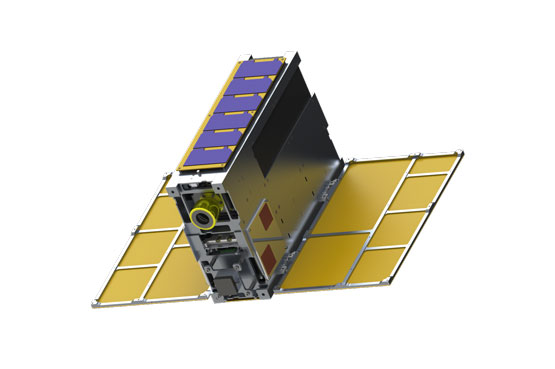
A rendering of the design for the Little Innovator in Space Situational Awareness, or LISSA, nanosatellite.
“Space has become busier and more complex in the last decade, resulting in the space domain awareness being increasingly important for the Canadian Armed Forces,” says Scott McLelland, DRDC Director of Research and Development (R&D) for the Defend North America strategic focus area. “This research and development project will advance understanding of the situation in Earth’s orbit, improve monitoring of objects orbiting Earth and help address these new space operational realities.”
In March 2023, Minister of National Defence at the time, the Honourable Anita Anand, announced that Canada awarded a contract for the Redwing space domain awareness microsatellite project, valued at $15.8 million, to be designed, built and operated in Canada. Now, Canada has signed a contract option to add a $900,000 subsatellite to the Redwing project. The subsatellite, known as Little Innovator in Space Situational Awareness (LISSA), will launch with the Redwing satellite and will be deployed after Redwing is in orbit.
“The two satellites will work together to reduce future risks to Canada’s space infrastructure from space debris or human-caused interference in congested orbits,” says DRDC defence scientist Lauchie Scott.
LISSA will follow the same orbit as Redwing up to 200 km behind in a “tandem formation flight.” Both satellites will travel in a low-earth orbit, at approximately 575 km above the Earth’s surface, and overfly the North and South poles.
Together they will test how to provide better space domain awareness with a focus on mega-constellations, which orbit at less than 2,000 km altitude. However, Redwing will also be capable of monitoring objects in altitudes approaching the Earth’s moon, known as cis-lunar orbits, at roughly 380,000 km.
Scott explains that the satellites will fill a gap in space domain awareness, particularly near the South pole, where there are few other sensors to track and monitor space objects. Redwing will be able to take images of space objects and to monitor space objects performing unexpected maneuvers. It will characterize and interpret active and inactive space objects helping to reduce the risk of future orbital collisions and reduce the risk of misunderstanding the behaviour of space operators.
Design, manufacturing and operations for Redwing is led by Magellan Aerospace, (Winnipeg, Manitoba), in collaboration with ABB (Quebec City, Quebec), C-Core (St Johns, Newfoundland) and academic partners York University (Toronto, Ontario) and University of Manitoba (Winnipeg, Manitoba).
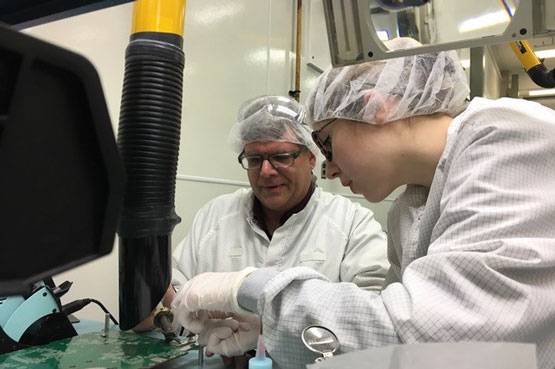
Students from University of Manitoba will be working with Magellan Aerospace to build the new Little Innovator in Space Situational Awareness, or LISSA, nanosatellite.
LISSA is subcontracted from Magellan Aerospace to the University of Manitoba. Dstl is partnering to provide a short-wave infrared (SWIR) camera, which LISSA will carry as a payload. The SWIR camera records outside the visible light spectrum and will address the technical challenge of reflected light from clouds and ice in the South Pole region during the Antarctic summer.
The ground stations for Redwing and LISSA will be in Inuvik, Northwest Territories and Happy Valley Goose Bay, Newfoundland and Labrador.
DRDC will direct the project’s science operations and perform data analysis in collaboration with the Royal Canadian Air Force.
Launch is planned for 2027.
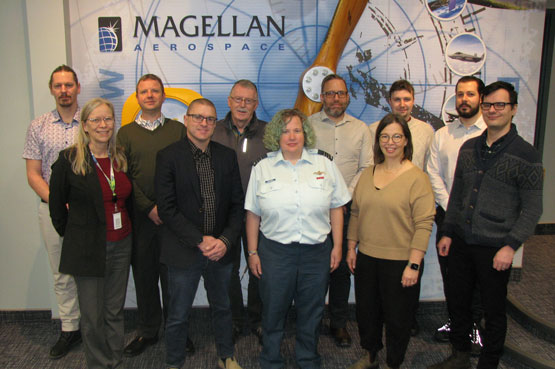
DRDC, RCAF and Magellan Aerospace representatives at the kick-off meeting for the Redwing microsatellite project in January 2023.