
July 24, 2024
With just 10 microlitres (one drop) of blood and five minutes for results, Defence Research and Development Canada (DRDC) is advancing health and safety monitoring at the annual NATO training event, Exercise PRECISE RESPONSE.
During the 2024 Exercise PRECISE RESPONSE, more than 400 military members from 13 NATO Allies are participating in simulated NATO task forces to train in chemical, biological, radiological, and nuclear (CBRN) defence scenarios.
DRDC Suffield Research Centre staff implemented a blood test to monitor for the enzyme, acetylcholinesterase (AChE), in 2017, as an added health and safety precaution to the already rigorous safety procedures during the Exercise. Acetylcholine is a chemical messenger, or neurotransmitter, that helps nerves send messages throughout the body and is important for brain and motor neuron function. AChE is an enzyme that helps the body regulate the amount of acetylcholine that remains active once it has been released by the nerve and thus allows the return of normal nerve function. When a person does not have sufficient active AChE to help control acetylcholine levels in the nerve, there can be elevated amounts of acetylcholine in their system. This can lead to prolonged action of acetylcholine at the receptor, which can result in health problems that may require medical care. This reaction is consistent with exposure to nerve agents, making AChE levels a good early indicator of exposure to toxic chemical compounds like organophosphates.
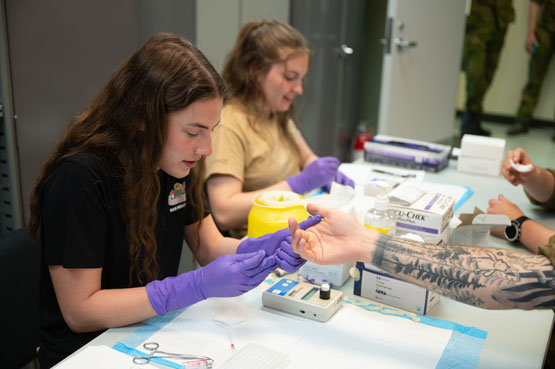
DRDC Suffield staff administer an acetylcholinesterase enzyme test during Exercise PRECISE RESPONSE.
During the first week of the annual Exercise, DRDC Suffield staff take a baseline measurement of the AChE enzyme from a finger prick blood sample from participants from NATO Allied countries. Each individual will have a slightly different baseline number of this enzyme, which can be impacted by a variety of genetic and environmental factors, including previous exposure to pesticides.
DRDC Suffield staff take this measurement using a point-of-care diagnostic device, which is slightly larger than the average mobile phone and provides a result within five minutes.
After a training exercise with a chemical agent, and completing the decontamination process, the members are then tested again, and their results are compared to their individual baseline number. If there is a change of plus or minus 20 per cent from that baseline, this would be an early indicator of a potential exposure to a chemical agent.
The AChE assay would allow DRDC Suffield staff to refer a person to medical care before any symptoms develop and this early intervention would prevent harm and allow more effective treatment.
This health and safety monitoring has been implemented at every Exercise PRECISE RESPONSE since 2017 and no members have required additional medical treatment, indicating the success of the safety procedures for the Exercise.
Being able to conduct this test on site has allowed DRDC Suffield to get effective results in minutes, rather than the average turnaround time of 48 hours in external blood testing labs, which would be too long to be useful. DRDC Suffield is interested in licensing this technology to a Canadian manufacturer to ensure its continued ability to access these point-of-care testing devices in the future. Any interested innovators should contact DND.ADMPAST-SMAAPST.MDN@Forces.gc.ca.
Related links:
- Train like you fight: DRDC supports realistic training with NATO Allies
- Exercise PRECISE RESPONSE 2023: Coordinating Common (De)Contamination Procedures
- Defence Team News: Exercise PRECISE RESPONSE 22
- Remote Threat Detection: DRDC tests the limits of sensors on drones in NATO trial
- Defence Research and Development Canada
- Defence Research and Development Canada Suffield Research Centre