
February 2026 | Canadian Food Inspection Agency | by the GRDI AMR-OH project team
What if common infections in animals and humans became untreatable? Antimicrobial resistance (AMR) is not just a phenomenon observed in the lab – it has emerged as one of the most critical threats to global health and economic security today. Bacteria that were once readily treated with antimicrobials are evolving into "superbugs" that can resist some of our most important medications. As these resistant strains spread, common infections risk becoming untreatable, potentially undoing decades of progress and returning us to an era before effective antimicrobials.
The One Health principle recognizes that the health of people, animals, plants, and the environment are interconnected. To effectively combat AMR, we must also look beyond any single source and track its development and spread across all sectors, from natural systems to healthcare and agriculture. This holistic vision is the core mission of the Government of Canada’s Genomics Research and Development Initiative Antimicrobial Resistance-One Health (GRDI AMR-OH) project.
A nationwide team effort
Tackling a problem as complex as AMR demands unprecedented teamwork. The GRDI AMR-OH project brings together a diverse team of experts from across federal science-based departments and agencies, including:
- Agriculture and Agri-Food Canada
- Canadian Food Inspection Agency
- Environment and Climate Change Canada
- Fisheries and Oceans Canada
- Health Canada
- Public Health Agency of Canada
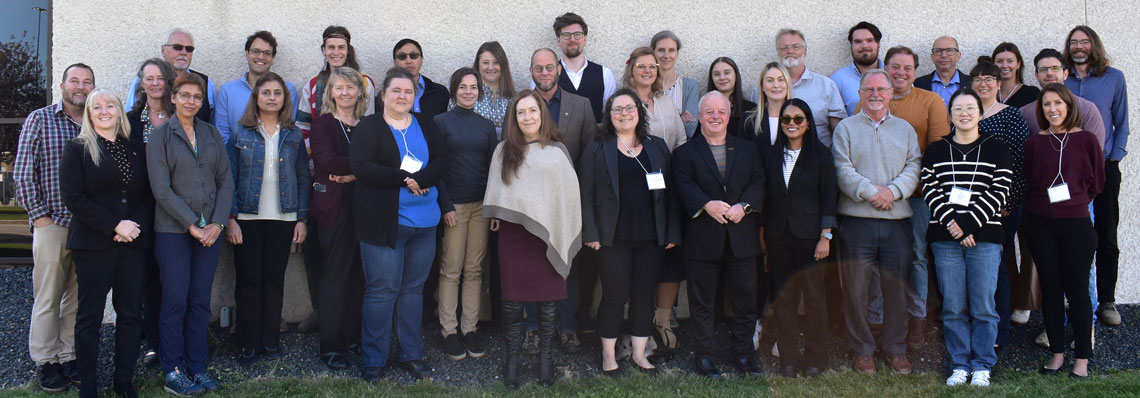
The GRDI AMR-OH project team at an annual general meeting in Winnipeg, MB.
This collaboration allows us to combine expertise, data and sector-specific knowledge to tackle complex challenges, such as:
- Identifying major "hotspots" for the development of AMR
- Investigating how AMR genes move between humans, animals, and the environment
- Studying how farm practices can minimize the development of AMR before it enters the food chain
- Determining if resistant bacteria found in our retail food supply are genetically linked to those causing infections in people
- Examining how fungicides and antibiotics used on farms contribute to creating drug-resistant bacteria and fungi, and their impacts to public health
- Assessing the impacts of AMR in agricultural runoff to aquatic ecosystems
- Evaluating and reducing the risk of AMR spreading across humans, animals, and the environment
- Exploring the role of genomic monitoring in detecting emerging AMR threats before they become widespread
An integrated, interdisciplinary approach is essential for understanding these issues and delivering meaningful health, economic, and environmental benefits to Canadians.
Genomics: the essential tracking tool
At the heart of the GRDI AMR-OH strategy is genomics – the science of reading and interpreting genetic information and the language of DNA. Using advanced technologies like whole genome sequencing (WGS) and metagenomics, federal researchers are decoding the complete genetic blueprint of resistant bacteria found in humans, animals, plants, and the environment across different sectors. Genomics has many applications for how we detect, trace, and respond to AMR threats, and provides important datasets that help drive further research and innovation in AMR.
Identifying targets for action
By analyzing data from different sectors, scientists can identify hotspots of AMR transmission like specific locations, production methods, or practices that disproportionately contribute to the spread of resistance. This helps to highlight and prioritize key areas for intervention.
High-definition tracing
Genomics allows researchers to connect the dots between resistant bacteria found in people, animals, food, and the environment, and establish precise transfer pathways. This helps pinpoint sources and transmission routes of AMR.
Informing policy and practice
The scientific evidence provided by genomics directly informs targeted solutions for AMR. For example, identifying links between the use of certain antimicrobials and the spread of certain resistance genes can lead to policy changes to ensure prudent antimicrobial use that protect both human and animal health without impacts to farm production.
Data interoperability
A cornerstone of the GRDI AMR-OH project is its commitment to the easy access and exchange of genomic and contextual data collected and generated by different departments, so that it can be compared and shared seamlessly. This open, standardized approach strengthens national surveillance and supports global cooperation in the fight against AMR. It also ensures that the rich data generated, which represents a significant investment of time, expertise and resources, is easily accessible and usable by regulatory bodies, international scientists, public health professionals, and industry partners well beyond the end of this project.
Real-world impacts: innovating alternatives to antibiotics in poultry
The GRDI AMR-OH project aims to deliver concrete scientific and practical impacts that benefit public health, the economy, and our environment. One focus of the project has been validating sustainable, non-antibiotic strategies for agricultural producers, including poultry farmers. These disease management alternatives are key to maintaining food production and animal health while mitigating the risks of AMR.
Berry-based feed additives
Breakthrough discoveries have shown that byproducts from fruit processing, like berry pomace waste, are rich sources of bioactives that can inhibit the growth of harmful bacteria or boost immune responses. This makes them promising alternatives to using routine antibiotics in animal feed. These substances may help to fight multi-drug-resistant foodborne bacteria such as Salmonella, pathogenic E. coli, Listeria monocytogenes, and Staphylococcus aureus.
Using these products as feed additives is a promising new strategy to keep animals healthy and reduce the risk from poultry diseases like necrotic enteritis caused by Clostridium perfringens and coccidiosis caused by Eimeria spp. These diseases can cause high mortality and major economic losses and traditionally have required the use of antibiotics.
This research guided Health Canada to provide experimental study certificates for including berry pomace in broiler feeds. Canadian poultry producers are now looking into adopting alternative feedings to maintain bird health, while simultaneously supporting a circular economy by using byproducts that would otherwise go to waste.
Next-generation vaccines
As scientists learn more about how diseases work, they are using modern technology to develop new vaccines that can offer better protection while being easier to use. Vaccine development is particularly important for priority pathogens with antibiotic-resistant strains. For example, research on non-typhoidal Salmonella has provided important new knowledge on how the bacteria acquires iron, which it needs to survive. Ongoing research is investigating the efficacy of novel plant-based nanoparticle vaccines that target Salmonella iron acquisition proteins. Exploring these novel approaches could lead to the development of safe, easy-to-use oral vaccines that help keep chickens healthy and prevent the spread of disease to humans.
Collaborating for a safer Canada
The GRDI AMR-OH project is a critical factor in better understanding AMR to protect Canadians and meet the needs of diverse sectors—from healthcare to agriculture—while preserving the effectiveness of life-saving antimicrobials. The outputs of this project continue to expand our collective scientific knowledge that can help mitigate the risks of AMR through effective policies and practices.
By continuously mapping the movement of resistance genes through the One Health continuum, we are helping to build more resilient food safety and public health systems for the future. Uniting scientific expertise across sectors is helping Canada make strides in the fight against superbugs, while protecting our health, economy, and the environment for generations to come.
More information
Explore a collection of open access peer-reviewed scientific publications from GRDI AMR-OH project collaborators. You can also access a repository of tools and documents related to the project on GitHub.
- Genomics Research and Development Initiative (GRDI)
- Antimicrobial resistance: What Canada's doing
- Not all bugs need drugs: Canada's top doc talks antibiotic resistance
- Resources on antimicrobial resistance in animals
- Antimicrobial resistance: Awareness materials
- Join the fight against antimicrobial resistance